USAID. BUR. FOR SCIENCE AND TECHNOLOGY. OFC. OF POPULATION
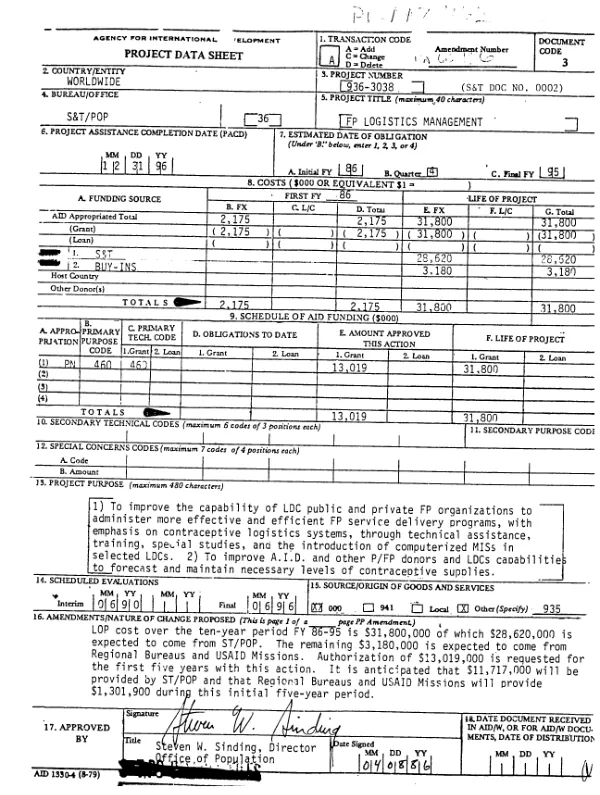
Family planning logistics management
Project to improve: (1) the contraceptive logistics systems of public and private family planning (FP) organizations in A.I.D.-assisted countries, and (2) the capability of A.I.D./W, A.I.D.
1986
Sign in to readA free account is required to download.
Abstract
Missions, other FP donors, and LDC"s to forecast and maintain needed levels of contraceptive supplies. A contractor or consortium and the FP Evaluation Division of the U.S. Centers for Disease Control will implement the project. Major project activities during the first 5 years of implementation will be, in the following order of priority, to: (1) estimate contraceptive requirements for each country; (2) assess the major FP logistics systems in each country (organizational structure, staffing patterns, resource allocations, and lines of authority); (3) conduct host country and regional workshops on the design and management of contraceptive logistics systems; (4) improve host country FP logistics management information systems; (5) assist in warehousing and shipping contraceptives to specified A.I.D. FP projects; (6) make physical inventories of contraceptive supplies in the highest priority countries; (7) help establish a computerized donor contraceptive information system (in coordination with institutions such as Pathfinder, UN Fund for Population Activities, the World Bank, and Family Planning International Assistance); and (8) prepare biannual country-specific reports containing information on contraceptive supply and demand and FP service and delivery systems. Initial priority will be given to the 42 developing countries with existing A.I.D.-supported population/FP projects. However, given the widespread need for improved contraceptive logistics systems, the number of country beneficiaries could expand to about 70 during the course of the 10-year project.
Related documents


![Family planning service expansion and technical support [SEATS]](https://covers.devme.ai/gen/14608.webp)