INTERNATIONAL CROPS RESEARCH INSTITUTE FOR THE SEMI-ARID TROPICS (ICRISAT)
Farming systems components for selected areas in India : evidence from ICRISAT
Research on natural watersheds in India has shown that using more input-intensive farming systems than those presently used in the semiarid tropics can substantially raise farm profits.
Binswanger, Hans P.; Virmani, S. M. +1 more · 1970
Sign in to readA free account is required to download.
Abstract
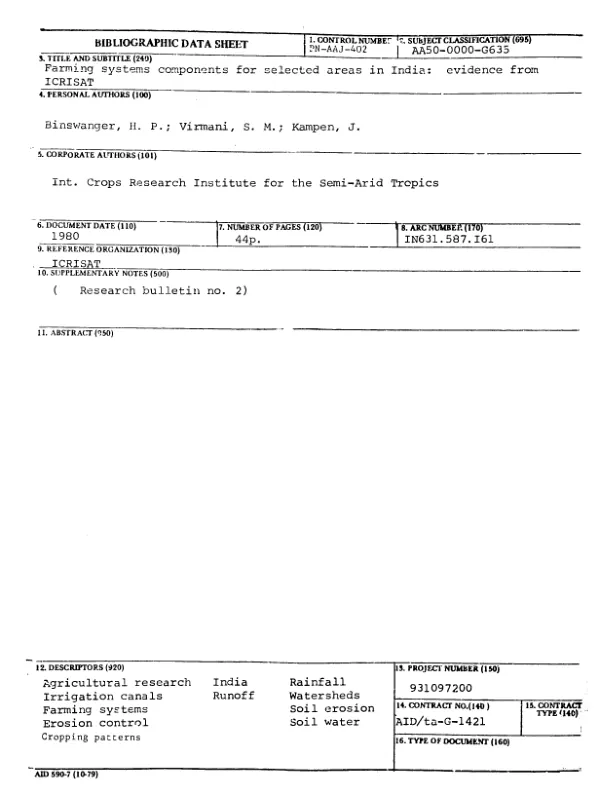
This report outlines successful soil and water management, cropping, runoff collection, and supplementary irrigation systems for use in the semiarid tropics. On deeper vertisols, intercropping maize and pigeonpeas is more profitable than maize and chickpeas; crop cover reduces runoff and soil erosion; contour bunds also reduce runoff and erosion but cause waterlogging in the monsoon season; broadbeds and furrows give greater yields and higher profits than flat planting, reduce runoff, and save bullock time during primary tillage; and while crop management across field boundaries is extremely difficult for small groups, short-term group efforts to improve soil and water management appear feasible. For shallow vertisols, intercropping maize and pigeonpeas produces higher yields and profits than maize and chickpeas; post-monsoon cropping based on residual moisture is impossible; crop cover reduces runoff and also reduces soil losses to acceptable levels; contour bunds cause waterlogging losses in rainy season crops; broadbeds and furrows are aided by fertilization; although broadbeds and furrows do not markedly decrease runoff or erosion or raise yields or profits, soil and crop management do increase yields and profits. Finally, in alfisols, broadbeds and furrows, as currently practiced, usually increase runoff and may lead to substantial soil loss; yields and profits do not vary significantly whether broadbeds and furrows or flat cultivation are used; contour bunds reduce runoff and soil loss; and soil and crop management raises yields and profits moderately. Appendices include a list of immediate research priorities, along with medium- and long-term objectives in classifying semiarid tropic production schemes; a 13-item bibliography (1971-80); and a table of data on runoff, soil loss, yield, and profitability.
Related documents