ABT ASSOCIATES
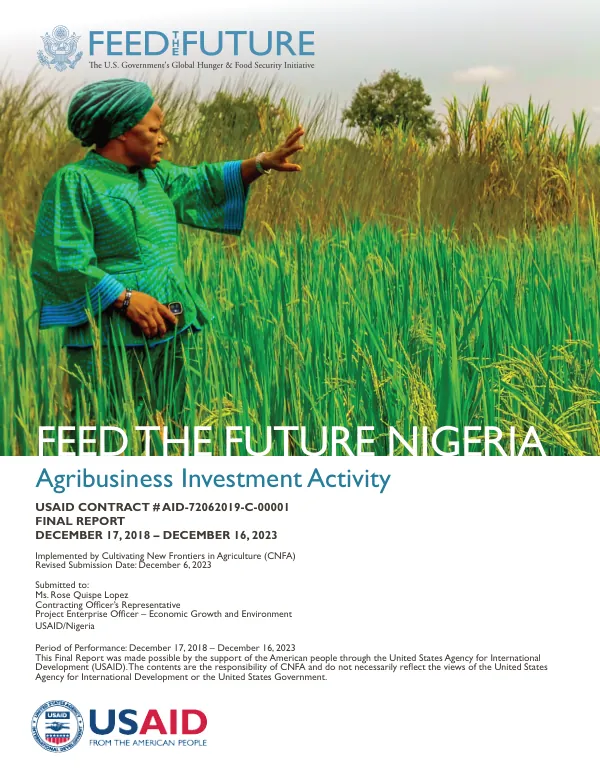
Feed the Future Nigeria Agribusiness Investment Activity Final Report
The Feed the Future Nigeria Agribusiness Investment Activity, funded by the United States Agency for International Development (USAID) and implemented by Cultivating New Frontiers in Agriculture (CNFA), has worked with various stakeholders to improve agribusiness finance and investment in seven states and five value chains in Nigeria.
2023 · 63 pages
Sign in to readA free account is required to download.
Abstract
The Activity brought together government officials, financial institutions, private equity firms, agribusinesses, civil society organizations, smallholder farmers, and other stakeholders to facilitate interactions and improve access to finance and investment for micro, small, and medium enterprises (MSMEs) working in agriculture. Through this collaboration, the Activity catalyzed over $244 million of finance and investment to 18,438 MSMEs, despite not providing any grants or financing directly to partners. This achievement was made possible by the strong relationships built between stakeholders and the commitment shown by state and federal actors to promote agribusiness growth for greater food security in Nigeria. The Activity consistently collaborated with federal and state policymakers to stimulate positive change in agribusiness finance. This included facilitating 68 consultative processes on agricultural enabling environment policies, resulting in 22 policies being implemented or revised with USG support. The Activity also worked to broaden access to agribusiness finance, with 17,716 MSMEs accessing credit through financial institutions and $188.83 million of additional agricultural-related financing facilitated. Furthermore, the Activity facilitated investment for agribusinesses, with 719 MSMEs accessing agricultural investment and $56.51 million of additional agricultural investment facilitated. The Activity also enhanced agribusiness MSME performance, with 93% of organizations trained showing improved capacity and 19,464 individuals participating in the Feed the Future Activity. In addition, the Activity promoted and facilitated greater engagement of women and youth in agribusiness, with 4,984 women-led and 2,600 youth-led organizations accessing finance and investment. The Activity also implemented a continuous implementation of the Communications and Knowledge Management Strategy, developing geographic and value chain-specific marketing and learning collateral. The Activity's success was also marked by the development of effective events, such as the Public Private Dialogue (PPD) and Finance and Investment Summits, which brought together stakeholders to discuss and address market issues. The Activity also conducted routine performance monitoring, field visits, data quality assessments, and assessments of the impact of the Activity. The Activity's exit strategy framework focused on improving the agribusiness enabling environment, broadening access to agribusiness finance, and enhancing agribusiness MSME performance. The Activity also promoted and facilitated greater engagement of women and youth in agribusiness. Lessons learned from the Activity included the importance of making policies and regulations adaptive to market innovations, avoiding subsidies to address market issues, and promoting widespread consultation and involvement of market actors. The Activity also recommended incentivizing more financial products targeting women and youth exclusively and addressing market dysfunction through organic solutions. The Activity's success was also marked by the achievement of several key performance indicators, including the facilitation of 68 consultative processes on agricultural enabling environment policies, the implementation of 22 policies, and the facilitation of over $244 million of finance and investment to 18,438 MSMEs.