DAI GLOBAL, LLC
Feed the Future Tanzania Land Tenure Assistance (LTA) FY’21 Q3 Quarterly Report
The Feed the Future Tanzania Land Tenure Assistance (LTA) program began developing Village Land Use Plans (VLUPs) for Ukwama and Mtamba villages in Mbarali District.
2021 · 30 pages
Sign in to readA free account is required to download.
Abstract
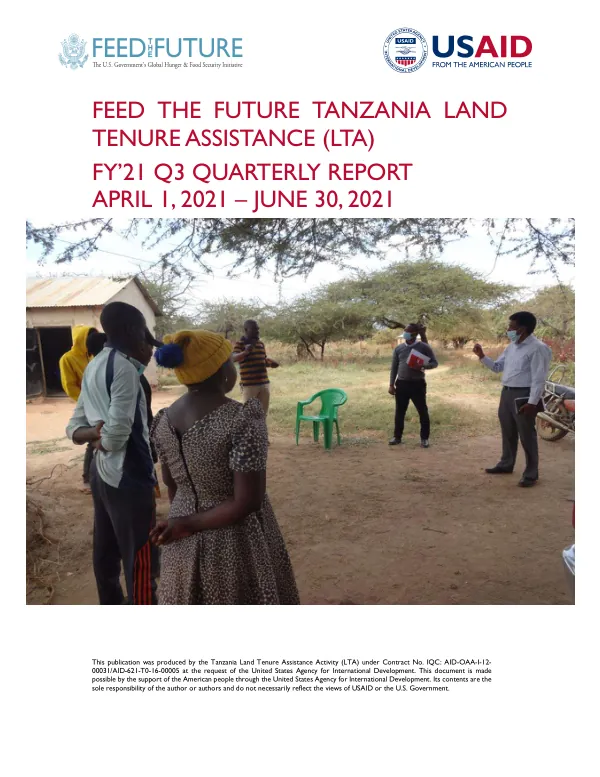
LTA also worked to obtain District Council approval of VLUPs prepared for Iringa District villages. In Iringa District, LTA successfully lobbied the District Council to include the review and approval of village land use plan bylaws for 11 villages on its full council quarterly meeting agenda. LTA completed the process of systematic village land registration in five villages in Iringa District, including Kaning'ombe, Ng'enza, Sadani, Mfyome, and Mibikimitali. A total of 6,133 Certificates of Customary Right of Occupancy (CCROs) were printed and registered. LTA also completed the demarcation and adjudication of land parcels in three villages in Iringa District, with a total of 8,675 land parcels adjudicated and demarcated. Public display for the results of adjudication and demarcation was completed in six villages in Iringa District. LTA organized CCRO issuance ceremonies in four villages in Iringa District, delivering 917 CCROs to respective Village Land Registries. The program initiated the Village Land Registration (VLR) process in Kilolo District, introducing the beneficiary contribution model to village councils and Village Assemblies in five villages. Village Councils appointed Village Land Registration Committee members and signed Memoranda of Understanding (MOUs) and Village Land Registration Agreements (VLRA) between villages, the Kilolo District Council, and LTA. LTA strengthened the capacity of village land governance institutions with respect to land administration and VLUP development. In collaboration with Kilolo and Iringa District authorities, LTA conducted 16 village council trainings in Kilolo, Iringa, and Mbarali Districts. The trainings covered topics including basic principles of land laws, introduction to the village land registration process using the Mobile Application to Secure Tenure (MAST), VLUP development, the land dispute resolution process, and the beneficiary contribution model. LTA continued to raise awareness of village residents with respect to land rights. In collaboration with the Mbarali, Iringa, and Kilolo District Councils, District Land Offices (DLOs), and the Regional Assistant Commissioner for Lands in Mbeya, LTA conducted 17 village assembly trainings and 56 hamlet level sensitization trainings. The trainings focused on the development and enforcement of VLUPs, land rights of vulnerable groups, introduction to the village land registration process, the beneficiary contribution model, and dispute resolution. LTA provided women's sensitization and awareness trainings on land rights in 10 villages in Iringa, Mbarali, and Kilolo Districts, attended by 821 women, including 340 youth. The participants were trained on women's land and property rights in accordance with Tanzanian laws and women's roles in decision-making on village land matters. Additionally, LTA provided trainings to six women's savings and agriculture groups in three villages in Iringa. The pace of LTA's field activities has been contingent upon beneficiary contribution. In the reporting quarter, LTA redoubled its efforts to boost beneficiary contribution in Iringa, Mbeya, Mbarali, and Kilolo Districts. LTA organized Village Assembly, Village Council, and Hamlet level meetings to encourage beneficiaries to make their contributions in accordance with the agreement they made with LTA. LTA staff also communicated directly with beneficiaries from two villages in Mbeya District, 11 villages in Mbarali District, and 18 villages in Iringa District. LTA organized for VLRC members from 17 villages to travel to Iringa Municipal to deposit beneficiary contributions in their NMB bank accounts. LTA also organized on-site visits of NMB Wakalas (bank agents) to facilitate collection of beneficiary contributions. LTA continued laying the groundwork for ensuring the sustainability of its activity through a financially and organizationally viable successor NGO. In the reporting quarter, LTA made focused efforts to secure funding for the successor NGO.