PRAGMA CORP.
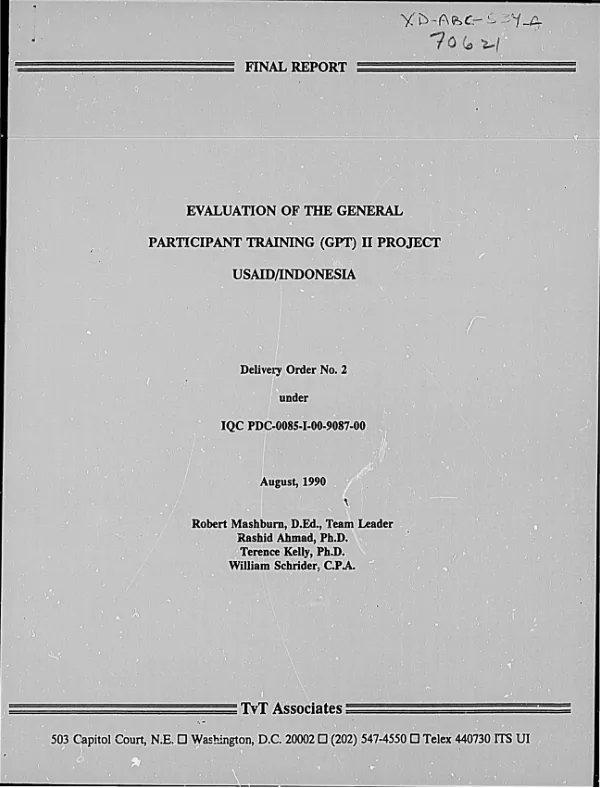
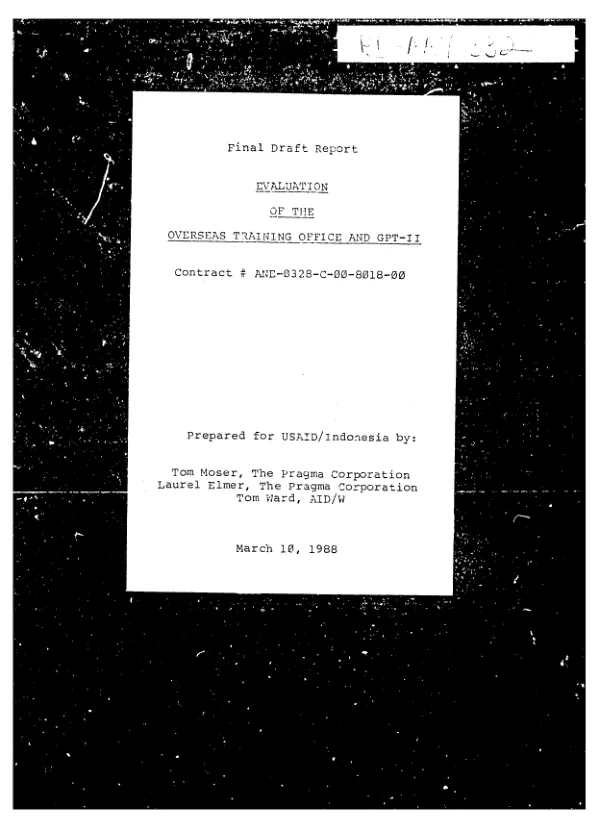
Final draft report : evaluation of the Overseas Training Office and GPT-II
External evaluation of a project component to build the Government of Indonesia's (GOI's) institutional capacity to plan and implement overseas training programs.
Moser, Tom|Elmer, Laurel|Ward, James Tom · 1988
Sign in to readA free account is required to download.
Abstract
The evaluation covers the period 1984-2/88. With project funding and TA, the GOI's Overseas Training Office (OTO) has made notable progress. More than 600 academic and technical participants have been programmed for training in a variety of fields, exceeding overall project targets. On the negative side, the project was less successful in meeting objectives to involve women and universities. Of a target 30% of project funds for these areas, only 3.8% of funds were used for the not-for-profit private sector and only 9% for women. The OTO now has the capacity to cover all major components of the training cycle, and its services have been widely accepted by other agencies involved in overseas training. These services include: (1) departmental training for the planning and selection processes; (2) academic aptitude testing in the Indonesian language; (3) an English-language training program; and (4) pre-departure cross-cultural orientation. While these services have helped institutionalize the OTO, its status as a permanent GOI entity needs to be formalized. Currently, OTO's personnel are borrowed from other GOI agencies, its mandate derives from the Ministry for Administrative Reform, and its operating funds come from A.I.D. and the World Bank. It is recommended that the GOI formalize the OTO by establishing a permanent OTO office in Jakarta with its own budget and staff. This measure could increase donor support for the OTO, which currently is at a lower level than originally anticipated. It is also recommended that the OTO conduct workshops and research to strengthen its training plans, review selection procedures, and improve its participant monitoring and follow-up activities. The OTO should also improve communication with other GOI agencies, as well as private sector organizations and donors, and maintain a centralized database of all sponsored trainees. It is advised that A.I.D. continue short-term funding of the OTO, as no other sources of financial support currently exist. A U.S. institutional contractor should also be engaged to provide continuing training support services in the United States over the next several years.