USAID DEC
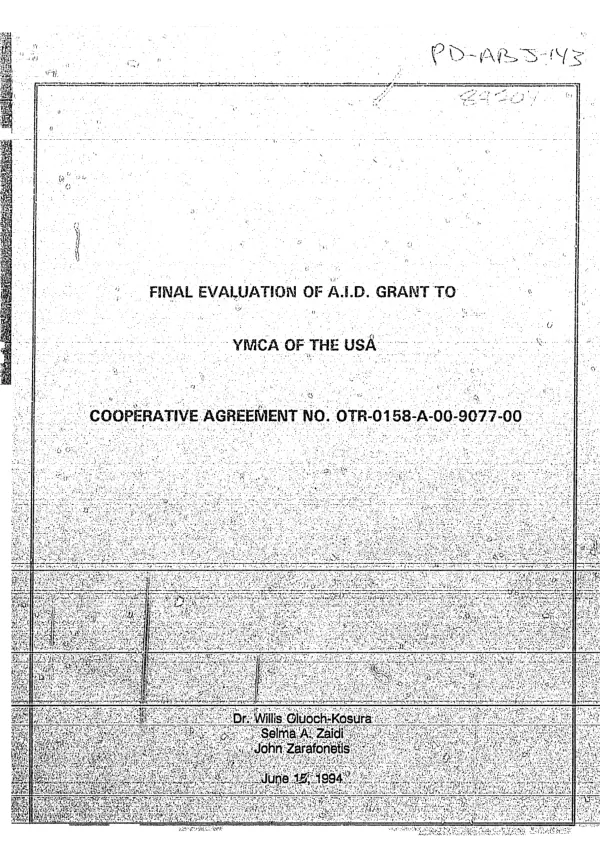
Final evaluation of AID grant to YMCA of the USA : cooperative agreement no. OTR-0158-A-00-9077-00
Sign inUSAID. BUR. FOR HUMANITARIAN RESPONSE. OFC. OF PRIVATE AND VOLUNTARY COOPERATION (PVC)
Final evaluation of AID grant to YMCA of the USA : cooperative agreement no. OTR-0158-A-00-9077-00
Final evaluation of a matching grant (9/89-9/94) to the YMCA to strengthen YMCA National Movements and their local associations in the Third World, especially in Africa.
Oluoch-Kosura, Willis|Zaidi, Selma A.|Zarafonetis, John · 1994
Sign in to readA free account is required to download.
Abstract
The main activity was provision of a block grant to the Africa Alliance of YMCAs, a consortium of 26 African YMCA movements. Under the block grant, National Movements in 13 African countries received project and institutional support through grants of $25,000 or under, workshops in development and strategic planning, and/or visits by Alliance staff. The Alliance's administration of the grant improved considerably after the mid-term evaluation in such areas as project approval and financial management, the latter due to the recruitment of an accountant as recommended in the evaluation. There was also a steady improvement in communications between the Alliance and the National Movements, as well as fewer and shorter delays in the disbursement of funds. Additionally, increased dialogue within the Africa Alliance and between the Alliance and the YMCA's International Division has resulted in better, clearer projects with improved transparency, communication, and accountability. The block grant (which broke with the YMCA's past practice of providing project-specific funds) has strengthened the institutional role of the Africa Alliance, moving it from a fragile advocacy and clearinghouse organization to that of grant maker and training provider. The Alliance has also taken inspired institution-building measures of its own, e.g., the adoption of strategic planning and a recent "think tank" forum to examine its mandate. Nonetheless, the Alliance has not found it easy to make the transition from a general service provider to a development assistance organization. It is still struggling with issues of institutional development, YMCA structure, training methodology, and partnership. Specific practical training in project management has not yet been implemented, and as a result, Movements are having difficulty in establishing project criteria, planning projects, sequencing activities, identifying local project leaders, transferring skills, mobilizing resources, monitoring and evaluation, and reporting. Alliance members are in particular need of training in basic community development. To date, the training provided by the Alliance in this area has been largely through workshops and seminars. However, these have mostly been one-time affairs, with little or no follow up. Also, while the Alliance recently developed 14 manuals for a Consolidated Leadership Development Program, the manuals have been criticized as being too theoretical. A more fundamental problem is that the YMCA has no clear definition of what a developed institution looks like. Its leadership largely consists of those versed in the values of a traditional service organization rather than in development matters as understood today. The African YMCAs, for their part, seem to be struggling to establish their identities. Some seem unable to move beyond the traditional service provider model, overstretching themselves trying to serve everyone in every way. Others seem compelled to attain financial self-sufficiency through income-generation schemes (some at cross-purposes with development goals) before moving to nonprofit, community-based efforts. Some appear as nascent community development organizations working to find their niche in the communities they serve. Other institutional deficiencies are that: (1) the YMCA's worldwide network (which would likely be greatly envied by many PVOs) is largely underutilized in promoting meaningful collaboration; (2) many YMCA staff and lay leaders seem unaware of the benefits of collaboration with non-YMCA donors and partners; and (3) lack of coordination between the YMCA's International Division in Chicago (which handles the matching grant) and its Africa Desk in Pittsburgh (which handles the YMCA's Africa affairs) has lessened the impact of the matching grant.
Related documents