USAID. MISSION TO HONDURAS
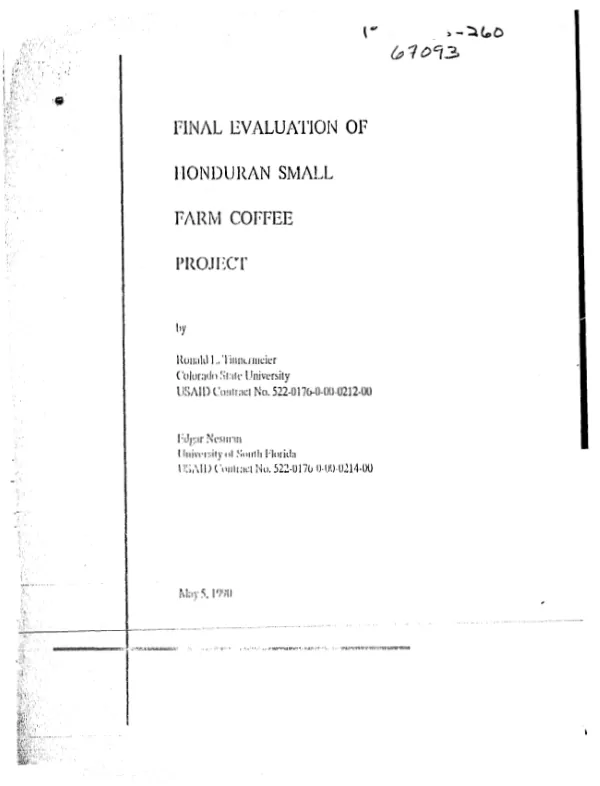
Final evaluation of Honduran small farm coffee project
Evaluates project to reduce the impact of coffee rust disease on small farmers in Honduras by strengthening the capacity of the Honduran Coffee Institute (IHCAFE) to develop and deliver needed services to farmers and by establishing a credit fund to be managed by the National Agricultural Development Bank and private banks.
Tinnermeier, Ronald L.|Nesman, Edgar G. · 1990
Sign in to readA free account is required to download.
Abstract
Final evaluation covers the period 1981-90. At the farm level, coffee yields increased from 6 to over 25 qq/manzana for those beneficiaries who planted during the 1982-85 period (i.e., those for whom the coffee plants have now reached full maturity). Coffee renovation covered about 13,003 manzanas -- above the goal of 13,000 for 1991. Soil conservation measures were initiated in all regions. IHCAFE has been able to directly service an estimated 9,815 small and medium size farmers, and the number is increasing about 700 annually. The goal of reaching 10,400 should be attained by the end of the project. Training of 119,000 individuals (some more than once) was also achieved in a total of 14,639 planned events. Farmers report substantial change in their coffee growing practices since the project began: 89% reported the use of field renovation (vs. 56% before); 83% now use fertilizer (vs. 30% before); 80% use insect and disease control practices (vs. 19%); and 89% use shade regulation (vs. 74%). Beneficiary satisfaction is high with 90% reporting few problems, which meets project requirements. Farmers report 64% of the renovated plots as "good" or "excellent." Three main advantages mentioned were: credit (52%); higher levels of production (49%); and technical assistance (27%). The use of new technology has spread beyond the financed plots with 68% of the beneficiaries also reporting the use of recommended practices on additional plantings of their own, and 55% reporting that their nonparticipating neighbors were using some recommended practices. Credit repayments total over 20 million Lempiras, which will permit continued lending in the future. On-farm coffee processing facilities were upgraded with the help of credit. Regular bank operating loans to cover annual coffee maintenance costs were extended to almost 50% of the beneficiaries. The project has given formal credit experience to 62% of the coffee beneficiaries for the first time. Many of these will now be eligible for regular bank credit. Data validity was good. Information gathered in the evaluation field survey was largely consistent with data provided by IHCAFE from other studies. However, some discrepancies exist between project and survey data. This could be due to bias by the extension agents collecting the data, or lack of accuracy by outside interviewers who were not well acquainted with the farmers' situation. Reports based on data collected by the project were available and are used in the regional offices. A central office planning and policy department was established by IHCAFE in 1986 and was beginning to use the reports and data for planning purposes. Key project problems encountered were as follows. (1) The crop diversification program has not been successful. (2) Soil testing results have not yet been incorporated in farmer recommendations. (3) Level of loan repayment is not as high as desired as 25% of the beneficiaries indicated that they were behind in payments. (4) Although most plots were in good or better condition, 12% were reported as "poor" or "lost." Finally, beneficiaries listed the major project disadvantages as high interest cost (36%), poor quality of seed plants (15%), and poor advice (10%). The project teaches the importance of (a) profitable technical recommendations to accompany credit, (b) continual efforts to improve intra- and extra- institutional communication, and (c) early attention to loan delinquency problems. It laos demonstrates the feasibility of incorporating private financial institutions in a small farm credit system and of using paratechnicians for direct farmer contact. It is laos evident that the poorest farmers are the hardest to reach, that felt needs (e.g., the problem of coffee rust) give incentive for change, and that training will have a lasting impact beyond project goals. (Author abstract)