USAID DEC
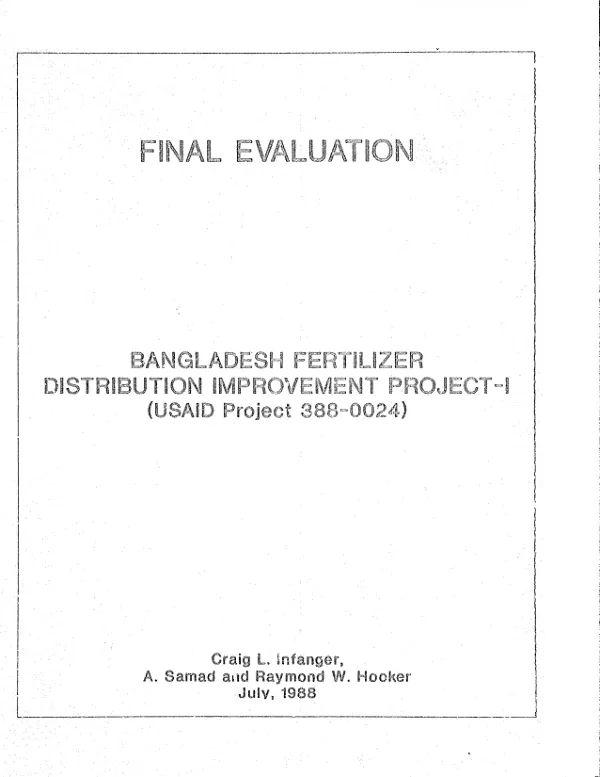
Final evaluation of the Bangladesh fertilizer distribution improvement - I project (USAID project no. 388-0024)
Sign inUSAID. MISSION TO BANGLADESH
Final evaluation of the Bangladesh fertilizer distribution improvement - I project (USAID project no. 388-0024)
Final evaluation of a project to increase fertilizer use on foodgrains in Bangladesh by supporting establishment of a private, free market fertilizer distribution system.
Infanger, Craig L.|Samad, A.|Hooker, Raymond · 1988
Sign in to readA free account is required to download.
Abstract
External evaluation covers the period 1978-5/88. While implementation of policy reforms has been slow, the project has made considerable accomplishments. Although overall foodgrain production increased only 2.5% per year during the project, against a target of 4%, Boro rice production increased 8% per year and wheat production increased 12% per year. Thirty-four warehouses with a capacity of 165,000 MT were constructed. Bangladesh Agricultural Development Corporation (BADC) gross fertilizer warehouse capacity is now over 400,000 MT, which is sufficient to meet current and short-term needs. Fertilizer imports under the project totaled 527,461 MT (about 13% of all fertilizer imports) and have helped close the supply gap experienced at the start of the project. The objective of increasing fertilizer availability on an equitable basis has also been achieved. Virtually all farmers currently use some fertilizer on foodgrains, and fertilizer is even widely available (although slightly more expensive) in remote areas. The project directly resulted in policy changes that have established a free market system of fertilizer distribution, which now handles 99% of all fertilizer and appears competitive and efficient. Retail fertilizer prices have gradually been completely decontrolled and fertilizer subsidies have been substantially removed. In neither case has there been a serious negative impact on fertilizer use. BADC dealer training has had a positive impact and is widely supported. However, the training has been sharply reduced since 1986, and should be restored and redesigned to reflect changes in the private marketing system. Although project implementation was slower than anticipated, A.I.D./W and USAID/B managed the project adequately and used a consensus approach to decisionmaking. TA provided to BADC by the International Fertilizer Development Center has been technically sound, problem-oriented, and timely. Several lessons were learned. (1) Agricultural development projects with major policy reform objectives should be expected to have long implementation periods (i.e., 5-10 years) if institutional change is to be successful. (2) Agricultural policy reform must be viewed as an evolutionary, step-by-step process. (3) Important agricultural reform is possible, given sufficient resources and USAID and host government committment.
Related documents