CAMP DRESSER AND MCKEE, INC. (CDM)
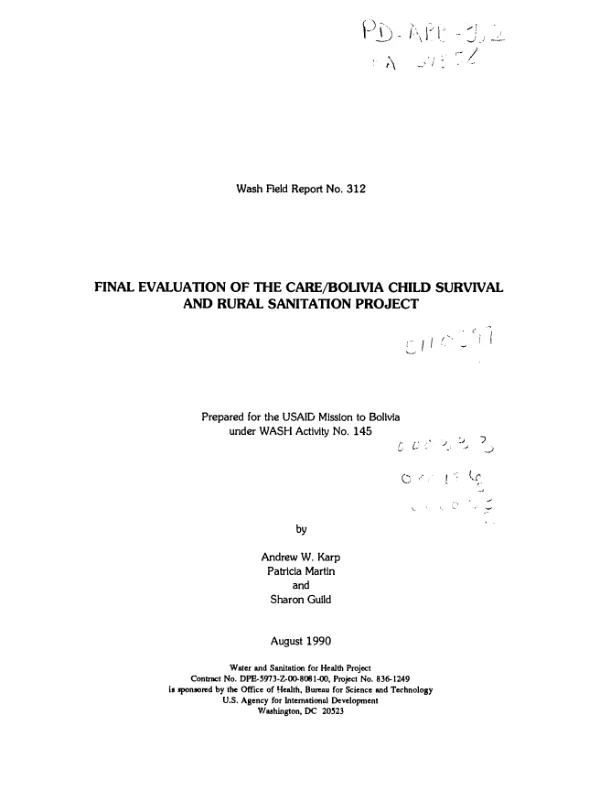
Final evaluation of the CARE/Bolivia child survival and rural sanitation project
Evaluates a child survival and rural sanitation project implemented by CARE in Bolivia.
Karp, Andrew W.|Martin, Patricia|Guild, Sharon · 1990
Sign in to readA free account is required to download.
Abstract
Final evaluation covers the period 8/86-8/90. The project was successful and benefitted some 59,000 people in 200 rural communities. The health education component achieved most of its objectives, including 90% immunization coverage, 50% oral rehydration therapy use, and 85% regular attendance for growth monitoring. In addition, the project's water supply systems were generally well constructed and water quality met WHO guidelines. Latrines were very well received, especially those with pour-flush water seals. However, some of the dry ventilated pit latrines were improperly constructed, had odor problems, and were unpopular. In a major project accomplishment, the community organization component created new or strengthened existing local groups (e.g., water committees, mothers' clubs) and encouraged community ownership of and responsibility for the water systems. Further, the project benefitted women, by helping incorporate them in the community leadership through the mothers' clubs and by saving them considerable time and energy in hauling water. The regional development corporations proved reasonably good counterparts, although they were excessively slow in the payment of funds to CARE. However, the regional health units (unidades sanitarias) showed less interest, partly because they were only asked to collaborate with activities that CARE and the corporations had already developed. Although it improved during its final year, financial monitoring was poor. As a result, CARE management learned two-thirds of the way through the project that an additional $0.65 million was needed. Key recommendations are as follows. (1) All counterpart institutions should be recognized as full and equal partners in project agreements. (2) A.I.D. could increase the effectiveness of its projects by urging coordination among projects in the same geographic area. (3) Due to their ongoing nature, water, sanitation, and health projects should avoid abrupt startup/termination and should run for at least 7 years. (4) In a developing country setting, bacteriologically polluted water should be treated with a slow sand filter (an effective and affordable low-technology technique) and not chlorination. (5) The project's policy of subsidizing all latrines, no matter how expensive, led to a depletion of funds before all communities requesting latrines could be served. A moderate fixed subsidy would be more equitable. (6) Any future project should find a way to provide health care to all children, even those whose parents do not or cannot afford to use the water system.
Related documents
Documents in this collection
 1990
1990USAID DEC
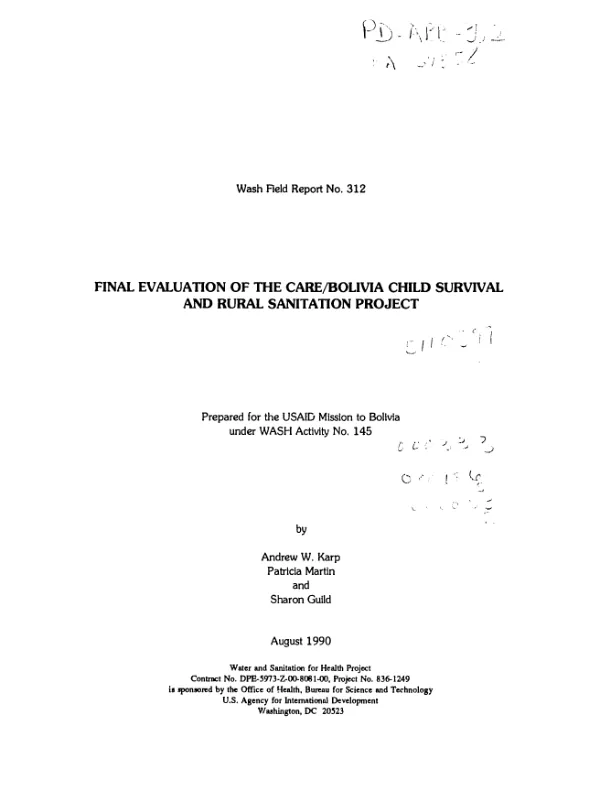
Final evaluation of the CARE/Bolivia child survival and rural sanitation project
Open record 2002
2002USAID DEC
![Wawa sana [healthy child] : mobilizing communities and health services for community-based IMCI [integrated management of childhood illness] -- testing innovative approaches for rural Bolivia : report of the Bolivia CS-16 midterm evaluation](https://covers.devme.ai/gen/5361.webp)