USAID DEC
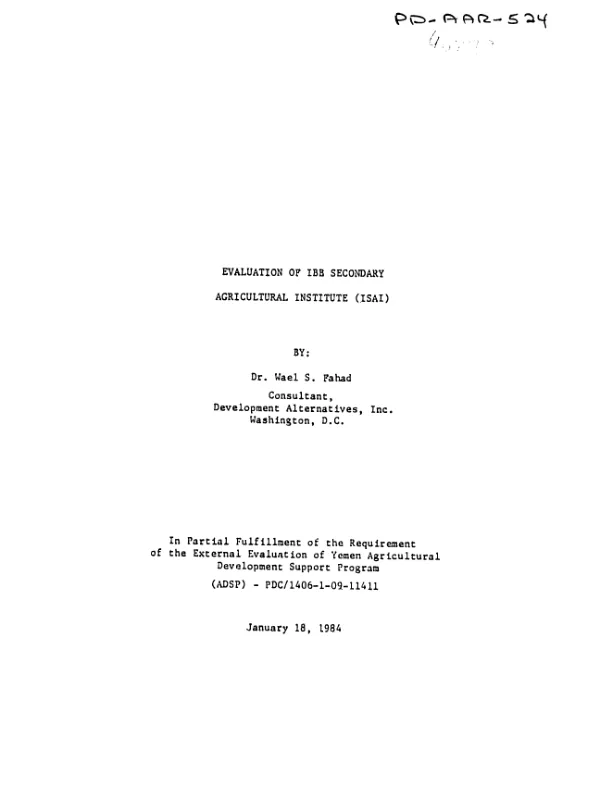
Final evaluation of the Ibb Secondary Agricultural Institute (ISAI), sub-project of the agricultural development support project (ADSP), (279-0052) in the Republic of Yemen
Sign inDEVRES, INC.
Final evaluation of the Ibb Secondary Agricultural Institute (ISAI), sub-project of the agricultural development support project (ADSP), (279-0052) in the Republic of Yemen
Final evaluation of a subproject (SP) to establish a secondary agricultural training institute (SAI) at Ibb in Yemen.
Kleis, Robert W.|Meisner, Robert G. · 1990
Sign in to readA free account is required to download.
Abstract
In 1985, the SP's scope was broadened to include establishment of additional SAI's at Surdud and Sana'a and to strengthen the Ministry of Education's Department of Agricultural Education (DOAE). External evaluation covers the period 1979-10/90. Except for strengthening the DOAE (which activity only began after the TA team moved to Sana'a in 1988), SP objectives were fulfilled. The three SAI's have adequate facilities and equipment. Instructional farms, agricultural mechanics laboratories, food technology facilities, and teaching resources centers are functioning, and a food technology facility at Surdud is under construction. Trained Yemeni SAI staffs are in place and utilizing a common competence-based curriculum with 17 "Yemenized" textbooks (references) and 132 specifically designed instructional modules. Although enrollments fluctuated early in the SP, they are now high. Female students, however, are not admitted, since co- education is not condoned at the secondary level, in contrast to the primary and postsecondary systems. Graduate placement is well developed, and many graduates aspire to college-level training. Establishment of a postsecondary agricultural institute should be considered to serve the technical needs of the rapidly developing agricultural sector. Sustainability of the SAI's largely depends on continued strong commitment and support by the Republic of Yemen. At the Ibb SAI, however, viability is threatened by problems related to an inadequate new director, who has caused great dissension and demoralization of teachers and support staff. High-level attention should be given to resolving this problem. A number of physical needs also require attention -- serious structural failures at Ibb (which pose a safety hazard), insufficient land area and dormitory capacity at Sana'a, and maintenance and equipment inventory/repair systems at all three SAI's. Several lessons were learned. (1) The SP should have encompassed the entire secondary agricultural education system at the outset and included plans to establish a teacher training program within the Faculty of Agriculture of Sana'a University. (2) U.S. training of all Yemeni teachers would have resulted in better training at lower cost than training in Egypt. (3) American- Yemeni co-directors of the Ibb SAI would have enable more rapid development, while providing valuable counterpart training for the designated Yemeni director. (4) The World Bank's standard secondary school design requires extensive adaptation for SAI usage. (5) The methodology of the project as a whole -- namely, the attempt to systematize several SP's under one umbrella project -- was naive and unnecessarily complex. (6) SAI staff should instill a sense of pride and dignity in practical, hands- on activity by students. This may require some cultural and attitudinal adjustment by the staff.