USAID. MISSION TO PHILIPPINES
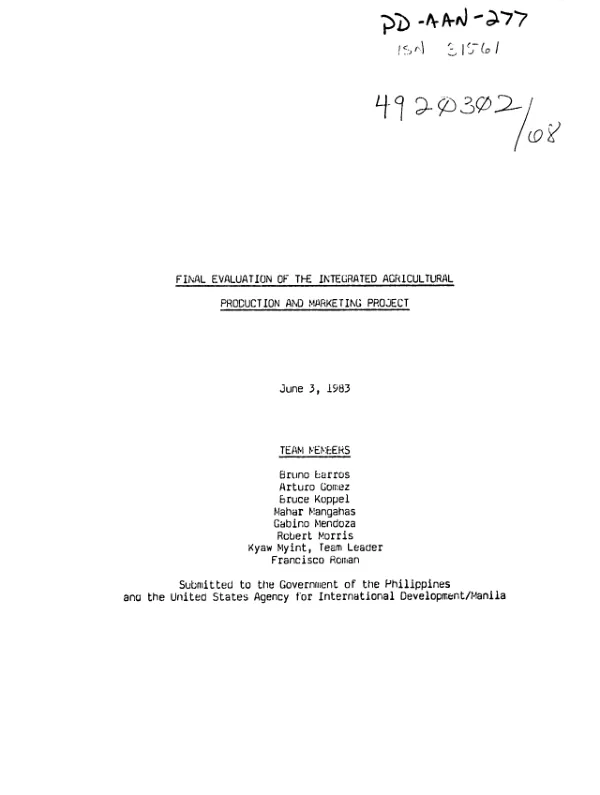
Final evaluation of the integrated agricultural production and marketing project
Evaluates project to develop the capacities of the Philippine Ministry of Agriculture (MOA) and of Central Luzon State University (CLSU) and the University of the Philippines at Los Banos (UPLB) to improve small farm production and marketing.
Barros, Bruno|Gomez, Arturo · 1983
Sign in to readA free account is required to download.
Abstract
External final evaluation covers the period 1977-1983 and is based on document review, interviews with project personnel and beneficiaries, and site visits. Despite major external changes (e.g., reorganization of the MOA and the reduction of its policy function by creation of the National Food Authority) and loose coordination, the project was a moderate success. Key achievements in the national policy thrust included upgrading the MOA's Policy Analysis Staff (the sustainability of which remains questionable) and the Bureau of Agricultural Economics's statistical capability, and MOA progress in addressing production-marketing linkages. In the academic thrust, 15 CLSU faculty, 81 UPLB faculty, and 65 UPLB students received graduate training; nondegree training was given to 13 CLSU faculty, 76 farmer leaders, 251 government professionals, and 19 cooperative workers. New academic programs were established in agricultural marketing, agribusiness management, and related areas. In the technical thrust, on-the-job experience helped CLSU staff develop 28 technical agricultural packages, 10 of which are ready for dissemination. However, the farmer adoption rate of CLSU packages has been less than 5% so far and the packages seem more appropriate to large than to small farmers. CLSU's controversial research and marketing food and feed grain processing centers will be completed later in 1983; a rigorous feasibility study before beginning operations is strongly recommended. The extension/outreach thrust successfully demonstrated the ability of the training and visit system to help local MOA workers implement agricultural development programs. A new thrust initiated in 1981 to integrate all four project thrusts in small area settings shows promise but needs further testing. Lessons learned are the need in complex projects for: a strong Executive Committee; involvement in project design by all agencies involved; and viewing such projects as learning experiences for the implementing agencies. Recommendations in all project areas are included.