USAID DEC
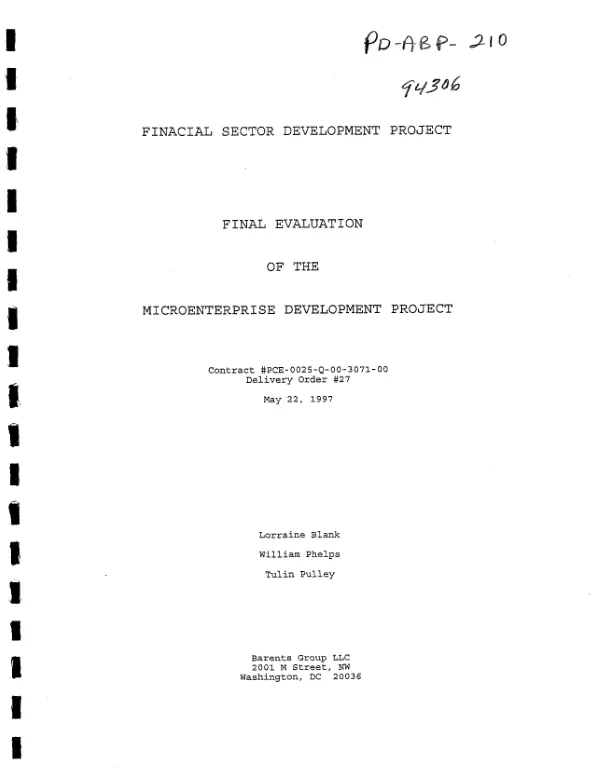
Final evaluation of the microenterprise development project : contract #PCE-0025-Q-00-3071-00
Sign inBARENTS GROUP LLC
Final evaluation of the microenterprise development project : contract #PCE-0025-Q-00-3071-00
Final evaluation of a project (4/90-5/97) to promote microenterprise development in Jamaica.
Blank, Lorraine; Phelps, William +1 more · 1997
Sign in to readA free account is required to download.
Abstract
Results were mixed. Institutional support provided to the Enterprise Development Trust (EDT), ASSIST, Ltd., and the City of Kingston Cooperative Credit Union was generally unsuccessful, resulting in loan portfolios that, in terms of size, quality, and impact, were well below expectations. Problems included difficulty in contacting borrowers due to poor transportation and violence in the targeted communities; the NGOs" failure to adopt the project"s minimalist lending approach; overly optimistic expectations for loan portfolio development; and failure to coordinate TA, training, and project management inputs with credit delivery. In contrast, TA and an in-house training program have benefitted the Workers Bank Program, the pace and quality of which is on target. The training component comprised institution-building and entrepreneurial training. Training of the first type helped 269 staff and board members from lending and donor institutions improve operations; study tours were especially effective in promoting the adoption of minimalist lending. Overall, however, the training did not have the anticipated impact, since it failed to match the developmental needs of participating institutions and did not sufficiently target decisionmakers. Entrepreneurial training was provided to EDT and ASSIST, and, on an introductory level, to over 5,000 microentrepreneurs. The impact of this training is not yet measurable. The training component also supported the production, in concert with the University of Technology Entrepreneurial Extension Center, of training videos in dressmaking, tailoring, day care, small-scale restaurants, and furniture manufacturing. These proved part of an interesting training model that can be duplicated in other countries. TA provided the East Westmoreland Craft Producers Association improved production, marketing, and sales, and had small but measurable impacts on income. The project provided the National Development Foundation of Jamaica (NDF/J) with equipment for a computer center, scheduled to open 5/97, which should reach over 400 entrepreneurs annually. Under the information and research component, modest project financing leveraged over $500,000 from other donors to support the National Surveys of Microentrepreneurs in 1992 and 1996, quarterly panel surveys, and other studies. These efforts increased the availability of reliable information on and hence planning in the microenterprise sector. The component also led to elimination of the interest rate ceiling for credit unions. Outreach to women was successful; 56% of loans were to female-owned enterprises, and 54% of entrepreneurs trained were female. The main weakness was lack of information on gender-disaggregated constraints and opportunities in the microenterprise sector. Overall, the project increased economic opportunities for the poor, though not as much as if APPLE anti-poverty loans had been disbursed. In terms of implementation, the provision of TA through centrally funded projects contributed to delays and lacked continuity. In addition, TA was not sufficiently emphasized in the project"s first 3 years; more focused efforts with decisionmakers would have increased acceptance of the minimalist lending approach. Also, the first Project Manager, who also functioned as the USAID Project Officer, left the project in 3/97; his replacement will likely have difficulty assuming both roles. Lessons learned are as follows. (1) It takes a minimum of 3-4 years to bring a credit institution to operational efficiency. During the developmental phase of a program, TA should be programmed on an ongoing basis and be designed to match the developmental time line of credit institutions. (2) Adoption of minimalist lending strategies requires a new way of thinking about credit for microentrepreneurs. (3) Every effort should be made to synchronize inputs from centrally-funded projects with those of other projects. (4) Management of complex projects such as this is enhanced through separation of the Project Officer and Project Manager functions. Use of an institutional contractor may be warranted. (5) To ensure its impact, training to strengthen lending institutions must be offered in conjunction with training for policymakers, which requires an ongoing mix of study tours, conferences, dialogue with directors of successful programs in other countries and ongoing interaction with technical advisors. (6) Experience with the studies program indicates, inter alia, that clearly delineated contracting arrangements for project-funded research are required.