WORLD VISION INTERNATIONAL, KENYA
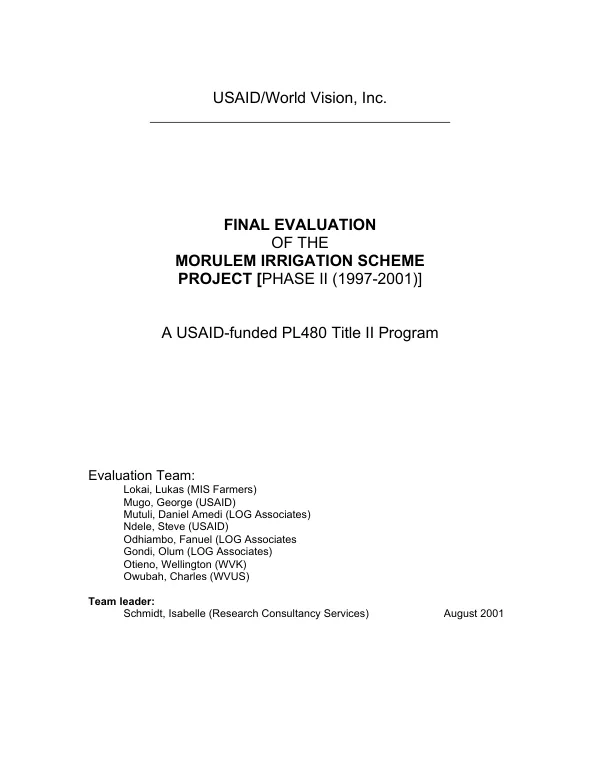
Final evaluation of the Morulem irrigation scheme project, phase II (1997-2001)
Final evaluation of phase II of a project to rehabilitate the Morulem irrigation scheme (MIS) in Kenya's Kerio river basin (1997-2001).
Schmidt, Isabelle · 2001
Sign in to readA free account is required to download.
Abstract
World Vision (WV) was the implementing agency. The project's main objective -- to increase household food production to 80% of annual grain requirements -- has been met and exceeded. Average household grain production during the past year supplied 138% of the household's grain needs. Tenure security has been enhanced by issuing identity cards and land allotments registered in the name of individual farmers. During Phase II, 1,528 farmers (300 more than originally planned) were given access to at least 0.5 acres each. The main reasons for the consistent yield increases during the project were the consistent training in improved agricultural practices and the high adoption rates thereof by farmers. Thanks to encouragement by WV, farmers have also started to a plant a greater variety of crops, and the percentage of farmers who sold cash crops increased significantly since the 1999 mid-term survey. The agroforestry initiative has been particularly successful. A total of 26,394 tree seedlings and 16,829 fruit trees (mainly paw-paw) were planted during Phase II. Two woodlots, comprising 4 acres in total, were also established in the areas where the excess irrigation water drains. Significant progress has also been made in the areas of nutrition (vegetable and fruit consumption), the provision and use of water from safe sources, and health and sanitation. The project also helped create at least 938 jobs (full and part-time), with the direct beneficiaries of these jobs estimated at 5,630. One of the project's strengths was the continuous and meaningful participation of the farmers during all stages of planning and implementation. The project's flexible, learning- based approach toward project planning, made possible by the flexibility of Title II resources, contributed significantly to project success. On the down side, lack of a baseline survey hampered monitoring and evaluation of the project. Other success factors included WV's acceptance of the traditional land allocation process, resulting in a high degree of compliance with scheme by-laws. The project's most significant impacts are as follows: (1) The irrigation scheme has diversified (and will continue to diversify) the local economy by creating jobs for both scheme and non-scheme members. This is happening in an area where there are no other job creators besides the government, a few local shop owners, and the missions. (2) Most scheme farmers are able to produce enough grain to feed their family throughout the year. Surpluses are sold on the local market, making grain more readily available to non-scheme members than before. (3) Scheme members have security of tenure with the possibility of title deeds in future. This may set the precedent for farmers who are members of other similar schemes. (4) Vegetables and fruits are being sold on the local market in an area where they have never been available before. (5) The large numbers of multiple-use trees planted provide fruit and by- products that farmers can use and sell locally, providing them with an income and making products such as paw-paw and neem available in the area for the first time. Many of the tree species planted, especially the nitrogen-fixing varieties, improve soil fertility in the area. (6) Trees are also for sale to non-scheme members and their benefits are available to the community at large. A private tree nursery was started as a result of scheme activities. The owner of the nursery also benefitted from the technical skills taught to scheme members. (7) Large numbers of community motivators and farmers have been trained in technical, management, and leadership skills that benefit both farmers and the community at large. The project is sustainable institutionally, environmentally, infrastructurally, and financially. Lessons and recommendations are detailed regarding irrigation infrastructure; the relation of extension agents to the Morulem Water Users Association (MWUA); soil fertility; agroforestry practices; animal traction; marketing and income generation; monitoring and evaluation of health, nutrition, and sanitation; and the privatization of hand pumps.
Related documents
Documents in this collection
![Final evaluation of 'emergency program to assist the vulnerable people in Liban [i.e Liben] Woreda, Borena Zone of Oromia Regional State [and] Filtu Woreda, Liben Zone of Somali Regional State'](https://covers.devme.ai/gen/5421.webp) 2002
2002USAID DEC
Final evaluation of 'emergency program to assist the vulnerable people in Liban [i.e Liben] Woreda, Borena Zone of Oromia Regional State [and] Filtu Woreda, Liben Zone of Somali Regional State'
Open record 2002
2002USAID DEC
![Final evaluation of "emergency program to assist the vulnerable people in Liban [i.e Liben] Woreda, Borena Zone of Oromia Regional State [and] Filtu Woreda, Liben Zone of Somali Regional State"](https://covers.devme.ai/gen/44245.webp)
![Report on the final evaluation for ADRA's projet d'augmentation des ressource[s] alimentaires de Siguiri (PADRAS) program (FFP-A-00-00-00085-00)](https://covers.devme.ai/gen/4985.webp)