DUAL & ASSOCIATES, INC.
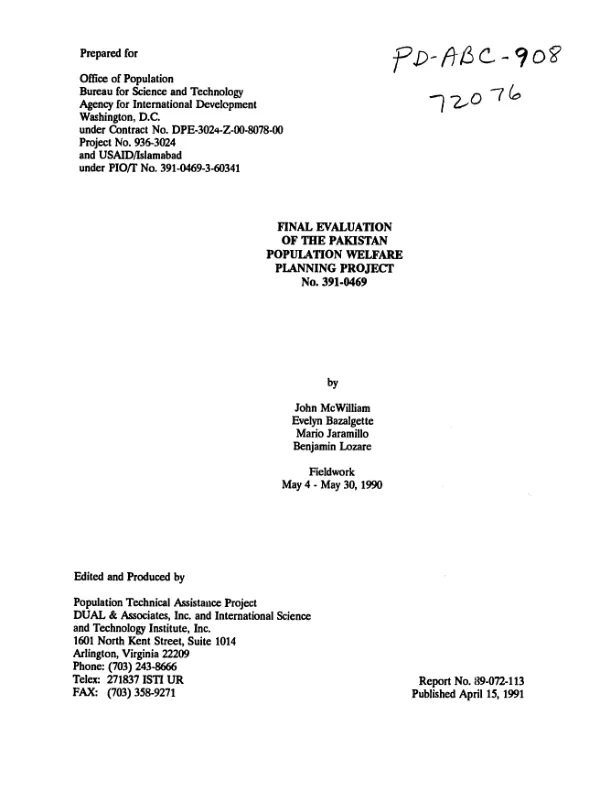
Final evaluation of the Pakistan population welfare planning project no. 391-0469
Final evaluation of a project to improve family planning (FP) services in Pakistan through contraceptive provision, support to private FP providers, assistance in voluntary sterilization, FP education, and training.
McWilliam, John|Bazalgette, Evelyn · 1991
Sign in to readA free account is required to download.
Abstract
External evaluation covered the period 1982-1990. The project provided most of the contraceptives used in the NGO and government FP programs. These were provided on a timely basis with few problems in logistics. USAID/P produced a manual that greatly improved contraceptive handling and distribution and it significantly improved storage by constructing a central warehouse in Karachi. Project TA helped the National Institute of Population Studies to become firmly established and produce high-quality research. Five research fellows are receiving advanced demographic training in the United States. The project also helped integrate FP into the health system by sponsoring training for selected Ministry of Health staff. Contraceptive prevalence appears to have increased from 9% in 1985 to 16%-18% in 1990. Furthermore, the more effective and longer-term methods, namely the IUD and voluntary surgical contraception, are becoming more popular. On the negative side, the project failed to implement an information, education, and communication strategy, and the NGO sector program did not develop as originally anticipated. The project emphasized opening service outlets rather than developing innovative NGO projects that could reach more potential acceptors, although the newly established NGO Coordinating Council is expected to improve coordination and services. The project's sustainability is uncertain. Because of the Population Welfare Division's failure to utilize the project's training and TA opportunities, little institutional strengthening took place. In particular, very few mid-level managers were trained, even though almost all senior staff will retire within 5-10 years. The long-term provision of contraceptives is also unsure, since no plans have been made on how to procure contraceptives once the project is completed. Since little attention has been paid to enlisting the private for-profit sector in meeting contraceptive needs, this task will continue to devolve largely upon the public sector.