USAID. MISSION TO ECUADOR
FINAL EVALUATION OF THE PRIMARY EDUCATION IMPROVEMENT LOAN
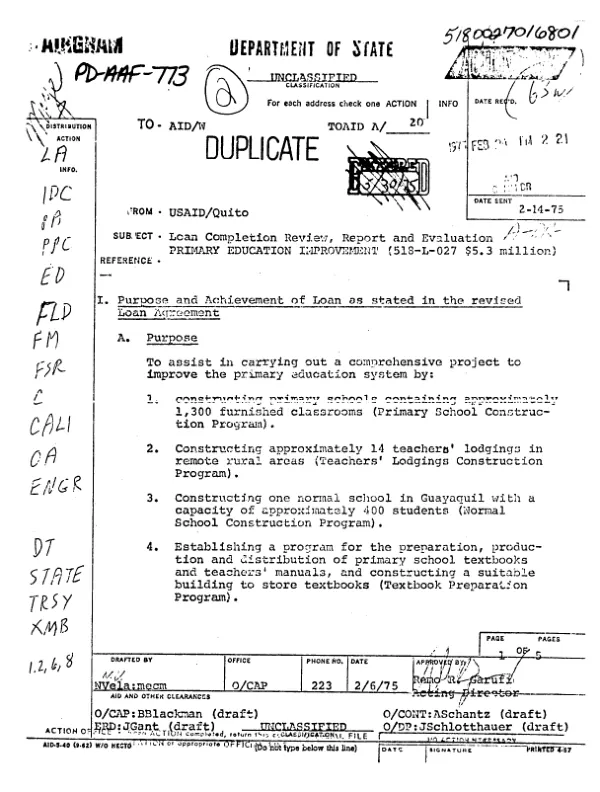
Evaluates project to implement a comprehensive primary school improvement project in Ecuador.
SCHLOTTHAUER, JULIUS P.|DUPUIS, BERNARD E. · 1975
Sign in to readA free account is required to download.

Abstract
This final evaluation covers a period ending 12/31/74 and is based in part on a loan completion report (PD-AAF-773-A1). No methodology is indicated. The loan is fully disbursed and terminated. As a result of a 1972 special evaluation, there was a major replanning of the project and an amended loan agreement. Largely because of inflation, the number of classrooms to be constructed was substantially revised downwards. The number of schools actually completed exceeded slightly the amended target. Despite the shortfall from the original target, the project purpose of creating a viable institutional framework capable of further activity was achieved. The quality of instruction improved considerably as a result of loan-funded textbook activity and related grant-funded materials preparation and teacher training programs. Although there is still a classroom deficit, loan-funded technical expertise and increased oil revenues should enable the Government of Ecuador (GOE) to redress this problem. The Ecuadorean Department of School Constructions is now self-sustaining and is producing seven steel-framed classrooms per day and over 300 metal school desks and chairs using a loan-funded prefabrication process. The GOE plans to triple this output by l975-76 and should overcome the classroom gap within five years. The loan helped the GOE to create a staff of over 200 professionals in the Ministry of Education to undertake and supervise school construction. In addition, a textbook department fully staffed with trained professionals was created. Over 2.5 million copies of 12 books written by department personnel for grades 1-4 have been published so far, and those for grades 5-6 will be published by 6/75. The GOE also created a national system of bookstores to sell and distribute educational materials. The project contributed considerably to the sector goal of helping the marginal poor participate in socioeconomic life. The assumption that these people would make use of loan-provided opportunities was verified.