USAID DEC
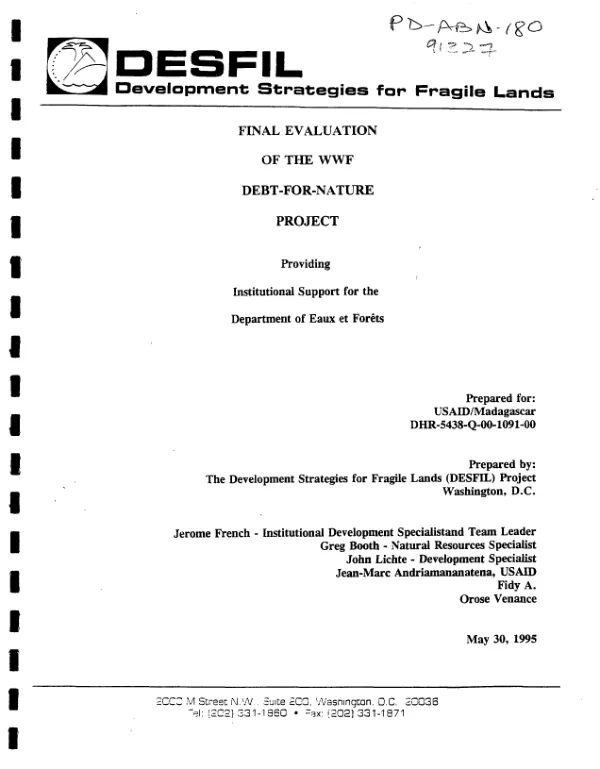
Final evaluation of the WWF debt-for-nature project providing institutional support for the Department of Eaux et Forets
Sign inCHEMONICS INTERNATIONAL, INC.
Final evaluation of the WWF debt-for-nature project providing institutional support for the Department of Eaux et Forets
Final evaluation of a debt-for-nature project (1989-1995) aimed at increasing the financial and technical resources available for protecting Madagascar"s natural resources.
French, Jerome; Booth, Greg · 1995
Sign in to readA free account is required to download.
Abstract
The World Wildlife Fund (WWF) and the Department of Water and Forests (DEF) implemented the project. The project has given the DEF much needed human resources support and provided a mechanism for villagers in buffer zones to become involved more directly and effectively in natural resource conservation and their own development. It also succeeded in improving DEF"s image and orientation towards its conservation responsibilities. Although the project is understood by the Malagasy conservation community, there is widespread disagreement over its underlying assumption that the roles of Agents for the Protection of Nature (APNs) and Forest Agents (AFs) can be harmonized and combined within DEF. There are also differing views both within DEF and within the broader conservation community on the roles of APNs, to the detriment of the latter"s effectiveness as conservation and development promoters within villages. The project had a small but positive impact on Madagascar"s external debt burden and financial situation. It is more difficult to assess the project"s impact on forest resource conservation and institutional strengthening of DEF because an adequate impact monitoring system has not been created. Nonetheless, there is some evidence that the project helped reduce the amount of forest clearing for agricultural use and bush fires. It also led to some reforestation and land and soil conservation efforts by villagers. The best results appear to be occurring in areas where APN village-related activities are associated with other donor-supported natural resource management efforts. Project staff are well qualified and highly motivated and the project is for the most part well administered, particularly considering its decentralized and highly dispersed character. The project is well integrated into DEF technically and administratively, but the DEF is not likely to assume funding responsibility for it in the foreseeable future. Further integration of the project into DEF should be deferred until the government"s new laws and policies on decentralization and forestry are applied in order to see whether an alternate institutional location of the project and the APNs might be more effective in improving natural resource management. Interim strategies for increasing impact are included in the report. The following lessons were learned. (1) Experienced and talented TA personnel can make a difference in an old, entrenched institution. The WWF/Debt/Nature technical advisor is helping to create a DEF work environment that inspires project and DEF staff, promotes individual creativity, and rewards community-level accomplishments. (2) Institutional support projects need to be designed with the same rigor as other projects. Hypotheses need to be tested, key questions continually asked, and impacts monitored. (3) It is worthwhile to seek out the experiences of other countries who have already embarked on similar projects. Lessons about organizational change, community-based natural resource management, and forestry agent functions from similar projects in Kenya and other development countries could have been very valuable during the design and early implementation phases of this project. (4) Collaboration and harmonization of activities is very difficult when there is no agreement between partners on how to achieve conservation objectives and the roles of field agents in working towards those objectives. (5) An established organizational culture may hinder the implementation of new organizational policies and orientations if the staff of the organization does not participate in the reorientation, or is not adequately informed of the need to change traditional practices. (6) To arrive at common approaches, all partners need to be well informed about what is happening "on the ground", which may be quite different from what is presented in formal documents and presentations. This will require significant time talking to villagers, something best accomplished by those who can speak the local language, are familiar with local customs, and have no stake in the activities concerned. (Author abstract, modified)
Related documents
Documents in this collection
 1995
1995USAID DEC
Final evaluation of the WWF debt-for-nature project providing institutional support for the Department of Eaux et Forets
Open record![Evaluation finale du projet echange dette/nature du WWF [World Wildlife Fund] apport d"un appui institutionnel a la Direction des Eaux et Forets](https://covers.devme.ai/gen/16807.webp) 1995
1995USAID DEC
![Gap analysis of district level community-based natural resource management [CBNRM] system capacity : final report](https://covers.devme.ai/gen/17194.webp)
![Sri Lanka : final evaluation of the shared control of natural resources [SCOR] sub-project -- final report](https://covers.devme.ai/gen/5940.webp)