PRAGMA CORP.
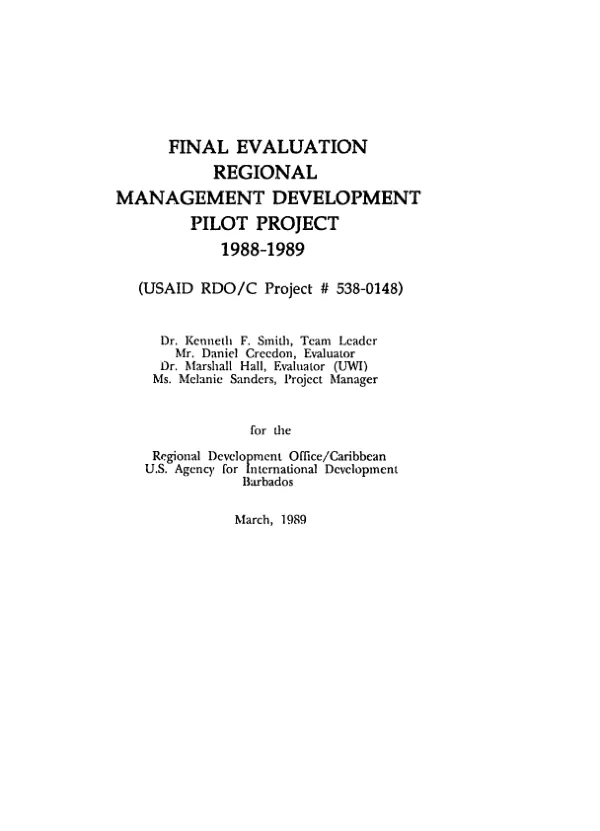
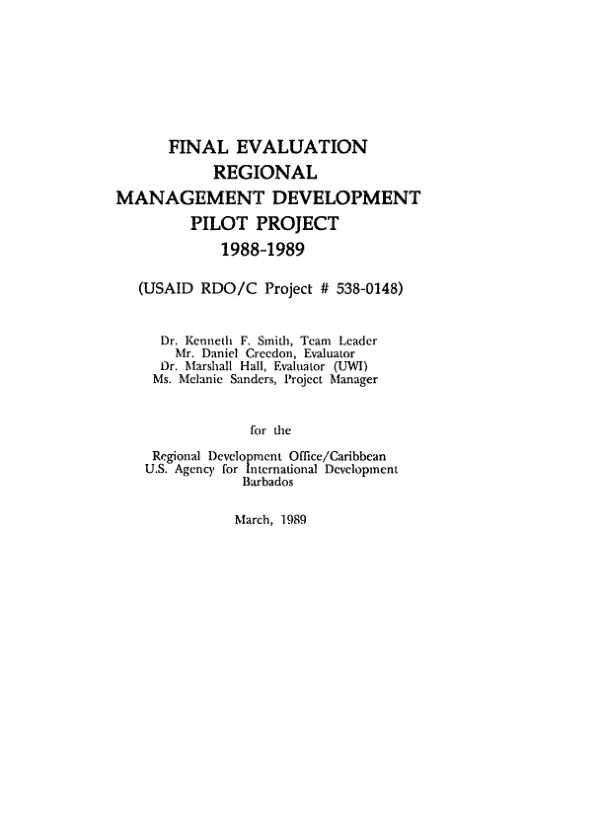
Final evaluation : regional management pilot project, 1988-1989
Evaluates pilot project to upgrade management skills in the Eastern Caribbean.
Smith, Kenneth F.; Creedon, Daniel · 1989
Sign in to readA free account is required to download.
Abstract
This was a process evaluation conducted during the period 3/88-3/89. The project was approved in 1986, but not actually initiated until 1/88. The evaluation team reached the following conclusions: (1) There was strong support for senior and executive development programs. (2) Participants were willing to pay an increasing share of the training costs and full airfare, room, and board. (3) Executive participants were willing to send their senior managers to the seminars. (4) A large number of Eastern Caribbean cases were developed. (5) There was only marginal support for the case writing and teaching workshops. (6) Virtually no changes have yet been realized in the use of action-oriented teaching approaches, including case studies. (7) Although the pilot project has forced an uneasy marriage between the leading members of the management education and training community, it did not contribute to any institutional strengthening of the University of the West Indies, the Caribbean Centre for Development Administration, or theBarbados Institute of Management and Productivity. The following lessons are highlighted for the benefit of follow-on project or similar institution-building education and training projects in the Eastern Caribbean region: (1) Symposia/seminars are extremely important for "networking" the private sector. Build in opportunities for formal participant interaction. (2) The Eastern Caribbean has a highly personal contact culture. People often only respond to highly personalized, face-to-face invitations, not "businesslike" approaches. (3) The project should be flexible and "demand-driven," not cast in a blueprint at the outset. (4) The public sector plays a major role in stimulating and/or constraining economic development in the private sector, but has limited awareness of business or how to heighten its impact. The two sectors need to work together more closely. (5) Cooperation and frequent communication between implementers and evaluators is essential in a process evaluation. (6) An on-going process evaluation requires a much more proactive USAID stance than do more traditional "one-shot" evaluations. (Author abstract)