USAID DEC
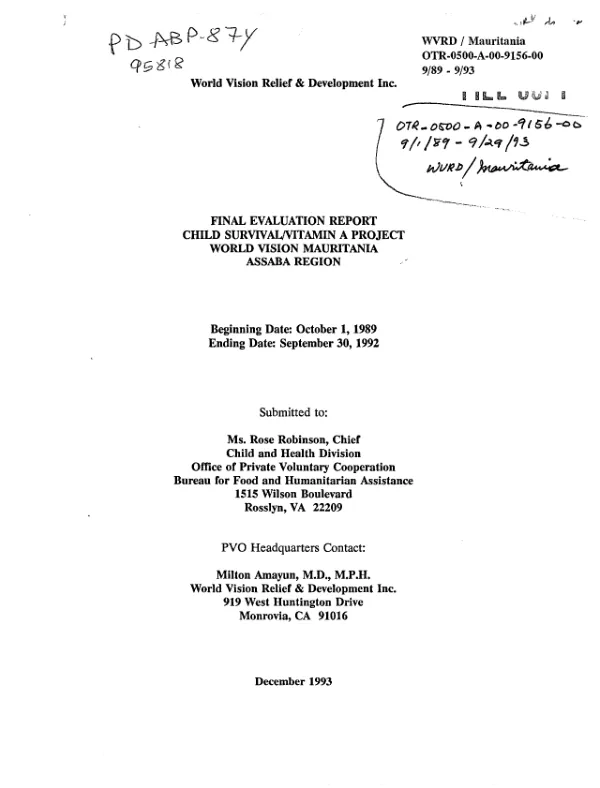
Final evaluation report : child survival/vitamin A project -- World Vision Mauritania, Assaba Region
Sign inWORLD VISION RELIEF AND DEVELOPMENT, INC.
Final evaluation report : child survival/vitamin A project -- World Vision Mauritania, Assaba Region
Final evaluation of a child survival/Vitamin A project (10/89-9/93) implemented by World Vision in Mauritania's Assaba region.
1993
Sign in to readA free account is required to download.
Abstract
Due to interruptions caused by the Gulf War, the APCD was extended from 3 to 4 years. At time of the extension a new component was added to integrate training efforts into the Ministry of Health's (MOH) primary health care (PHC) program. World Vision has achieved or surpassed all numeric goals related to the training of community health workers (CHWs) (45) and MOH staff (20) and the formation of community health committees (CHCs) (45). It has surpassed its objective of promoting gardening activities in 90 villages or cooperatives, and achieved its objective of promoting breastfeeding and oral rehydration in basic health units (BHU) or "emphasis" villages. It has fallen just slightly short of its objective of seeing that 70% of childbearing women receive at least 2 doses of tetanus toxoid in BHU villages. The only domain in which numerical goals have not been met is vaccination. Considering the local circumstances, the initial objective of 70% of infants being completely vaccinated before their first birthday appears to have been unrealistic. After aggressively promoting in the project's early years the distribution of Vitamin A capsules to children aged 6 months to 9 years and to mothers who had just given birth, World Vision decided to phase out these activities over the past year. While objectives related to this activity (which was considered temporary in any case) were not evaluated for the present report, the ample evidence that promotion of Vitamin A gardening is leading to increased intake of Vitamin A-rich foods makes World Vision's decision appear sound. Above and beyond meeting most numeric targets, the project has apparently left a lasting mark on the region through its emphasis on training health workers who are actively promoting health issues in many villages around the region. In addition, structures have been put into place that provide communities with the rudimentary capacity to confront their health problems themselves, e.g., CHCs, establishment of a fund for the continuous purchase of essential medicines. Gardening also has become a very important activity throughout the region and this project has played an important part in its promotion. Through its emphasis on training MOH personnel and assisting the MOH with immunization and its PHC program, the project has contributed to institution-building within the state structure. In sum, except for the lack of strong income-generating schemes, the project is/was quite competent in fulfilling its sustainability commitment. The following lessons were learned. (1) Knowledge-based or training-based activities are often self-sustaining, as well as sustained by external sources. The more one knows, the more one "needs" and wants to learn. This may be especially true for women in the Mauritanian culture. (2) There is a strong need for careful and intense planning and for gradual phasing activities and responsibilities over to the local communities, i.e., the health committees, etc. (3) Income-generating activities may develop from unexpected sources. One should be prepared to seize and make the best use of these opportunities. (4) Tribal rivalries may cause dissension within the community and lessen the effectiveness of the health committee. (5) The village committees have served as advisory councils in organizing the villages to achieve economic development and solve issues. The contacts between the village committees and the project staff gives an exact understanding of the people's needs. (6) Slowly but surely, a change is taking place in people's attitudes, behavior, and mentalities. Some old medical practices (full of risks) are ending, e.g., traditional treatment of diarrhea. (7) Supplying the villages with drugs provides access to modern medicines, saves money that would be used to transport patients to the city, and motivates people to take better care of themselves and take responsibility for their own health.