USAID DEC
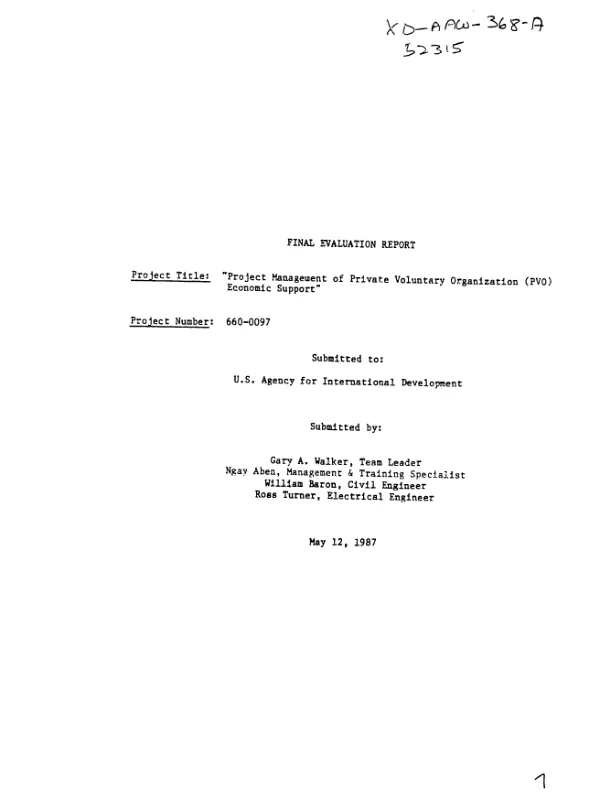
Final evaluation report : project management of Private Voluntary Organization (PVO) economic support
Sign inUSAID. MISSION TO ZAIRE
Final evaluation report : project management of Private Voluntary Organization (PVO) economic support
Evaluates project to establish a central umbrella fund in Zaire to support efforts to upgrade indigenous PVO's and to finance PVO subprojects (SP's).
Walker, Gary A.|Aben, Ngay · 1987
Sign in to readA free account is required to download.
Abstract
Final evaluation is based on interviews with project personnel and beneficiaries, document review and site visits, and covers the period 6/85-5/87. The project, which has three SP's (bridge construction, rural health upgrading, and mini-hydro construction), has achieved most of its objectives. Of nine planned bridges, seven are finished and the other two will be completed by the end of the project. Rural health inputs have complemented and reinforced the work of USAID/Z's major health project, Sante Rurale (SANRU), by providing commodities and strengthening administrative and financial management (in particular, the installation of solar electric systems has made it possible to protect the vital cold chain for vaccines and has provided back up electrical power to operating rooms). The mini-hydroelectrification facility is 65% complete as of 4/30/87, and scheduled for completion in 11/87. The project also had a major institution-building impact on the cooperating Zairean PVO in the Bandundu region, which was provided financial, management, and technical training, as well as TA in institutional reorganization. Overall, the Organization for Rehabilitation through Training (ORT) has an excellent record in managing this project - about 80% of commodities arrived on schedule, engineering and electrical contracting have been of good quality, and, while the project was first envisaged as a commodity supply project, ORT successfully developed an important institution building component as well, elements of which should serve as a model for future PVO development programs. The umbrella approach offers a means to reduce the A.I.D. management burden and costs, while at the same time encouraging indigenization. Such an approach, with some modifications, should serve as a point of departure for future PVO assistance projects. The project also teaches that (1) PVO assistance projects should focus on means rather than ends (i.e., development of local PVO's as viable development agencies rather than building roads, etc.); (2) efforts should be made to ensure that participating PVO's are truly indigenous, or at least fully committed to becoming so; and (3) sustainability must be carefully planned for from the beginning. In view of the delays caused by the bankruptcy of one of the mini-hydro contractors, concerns about inadequate Zairois involvement in the facility's development (and eventual management), and the deplorable working conditions at the construction site, it is recommended that the project be extended till 12/31/87, to ensure close supervision.
Related documents
![Mid-term evaluation of Karawa - health/education improvement thru [i.e. through] hydro power - project 660-0081](https://covers.devme.ai/gen/10998.webp)