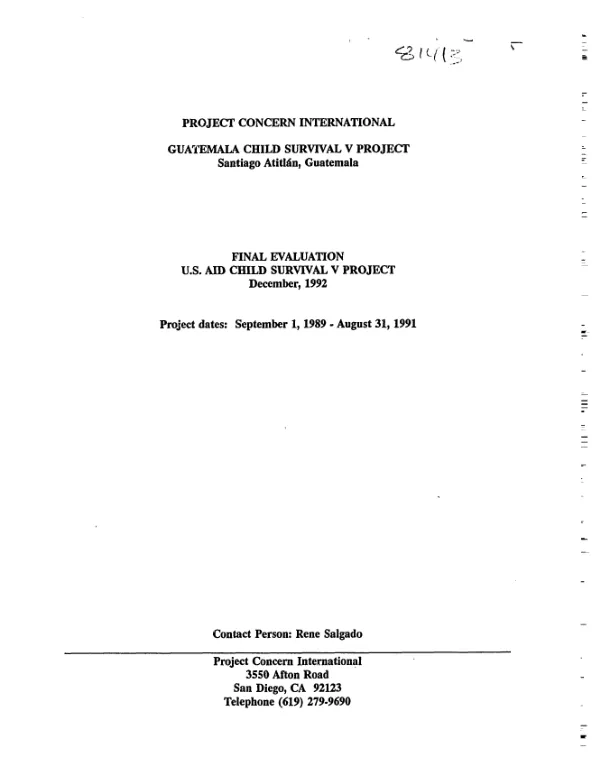
PROJECT CONCERN INTERNATIONAL (PCI)
Final evaluation : USAID child survival V project
Final evaluation, prepared by the grantee, Project Concern International (PCI), of the Child Survival V (CS V) project in Guatemala.
1992
Sign in to readA free account is required to download.
Abstract
The evaluation is based mainly on two large community surveys. The first survey was conducted in 7/91 to determine vaccination coverage in the Santiago municipality, and the second in 10/91 to address the remaining child survival components. In addition, data were collected from several small knowledge, attitudes, and practices (KAP) surveys, small focus groups, and the health information system used by PCI and community health workers (CHWs). This report refers to both sets of data. CS V funding has been used primarily to refine and improve existing PCI activities in the Santiago Atitlan area and to expand activities to San Jose Chacaya. Funding has permitted PCI to increase its immunization coverage of infants and children in the region; conduct Expanded Program for Immunization (EPI) training for CHWs and traditional birth attendants (TBAs); increase the referral of women for tetanus toxoid vaccination; expand the enrollment of children in the growth monitoring program; and increase the number of at-risk pregnant women referred to health services. In 3/90, A.I.D. funding for EPI and oral rehydration therapy (ORT) was suspended due to problems with the Ministerio de Salud Publica y Asistencia Social"s (MSPAS) financial management. While not directly affected, MSPAS-PCI relations were influenced and the supplies of vaccines and ORS impaired. The 1989 detailed implementation plan (DIP) sought an attendance rate of 90% for a six-session EPI training course for CHWs. One hundred and thirteen CHWs participated in this course, 18% more than were required. In addition, 19 TBAs were to receive EPI training, with emphasis on tetanus toxoid vaccination for women of childbearing age. The benchmark called for 90% of the TBA"s (17 out of 19) to attend the training course. Eighteen TBA"s attended the course, one more than required. Important lessons learned include the need for greater emphasis on the improvement of the health information system and better supervision of the planning and implementation of the project components. Barriers to change can be tremendous and surmounting them a time-consuming endeavor; these considerations should be factored into the formulation of the objectives of any community development program. Two recommendations are made to reduce dependency and promote program self-sufficiency. (1) A thorough investigation of ways to improve the efficiency of hospital program resources should be conducted; this would enable the hospital program to generate more of its own funding. (2) Members from both the hospital and community health programs should be trained in writing grant proposals, and on available funding sources. (Author abstract)
![Final evaluation : ADRA [Adventist Development and Relief Agency]/Rwanda -- child survival project : 1985-1989](https://covers.devme.ai/gen/6085.webp)
![Final evaluation : child survival project in Semuto and Butuntumula, Luwero District - Uganda -- AMREF [African Medical and Research Foundation, Inc.] Uganda project -- project period Oct, 1992 - Sep, 1995](https://covers.devme.ai/gen/85661.webp)