USAID DEC
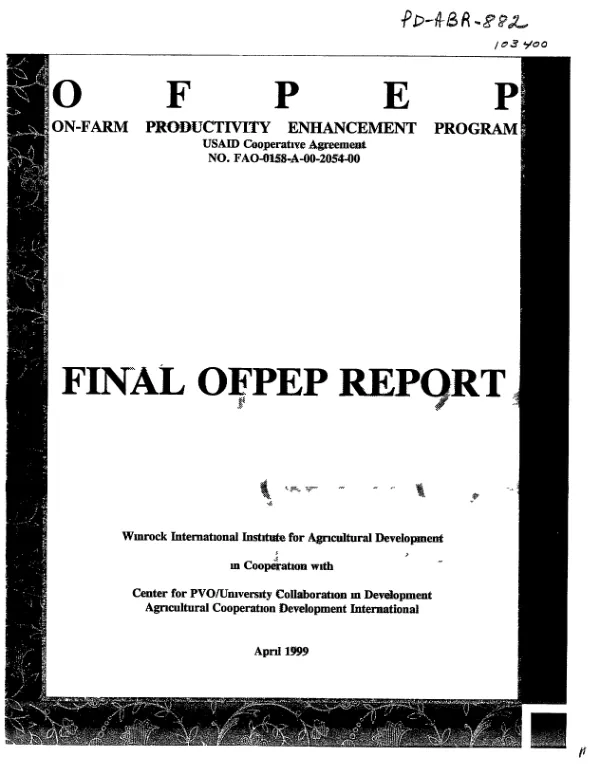
Final OFPEP (on-farm productivity enhancement program) report : USAID cooperative agreement no. FAO-0158-A-00-2054-00
Sign inAGRICULTURAL COOPERATIVE DEVELOPMENT INTERNATIONAL (ACDI)
Final OFPEP (on-farm productivity enhancement program) report : USAID cooperative agreement no. FAO-0158-A-00-2054-00
Final report of the lead contractor, Winrock International Institute for Agricultural Development, on the On- Farm Productivity Enhancement Program (OFPEP -- 9/92-12/98), designed to increase smallholder yields in Uganda, Kenya, Senegal, Gambia, and Ethiopia.
1999
Sign in to readA free account is required to download.
Abstract
Winrock implemented the project in collaboration with the PVO/University Center of Western Carolina University. OFPEP"s model of collaboration and partnering has been highly effective in changing the way knowledge is created and shared, and in building relationships between the public and private sectors. Other keys to OFPEP"s success include understanding gender roles in farm families, using appropriate technologies and techniques, and focusing on food security and cash generation. OFPEP has had an extremely positive impact, not only on the hundreds of thousands of farmers it has reached, but also on participating entities. For farmers, OFPEP has increased production of basic food crops, thereby shortening or eliminating the "hungry season" and increasing income in many households. It has also increased the prestige of women as agricultural producers and awareness of the importance of girls" education. The introduction of fuel-efficient stoves in Uganda has led to documented savings in labor and cash and has had a positive impact on the environment. New crops have been introduced in some areas, and ideas have changed regarding the cultural and economic significance of certain crops, notably soybeans in East Africa and rice in Senegal. There is increased awareness of gender issues and marked changes in some traditional male-female agricultural roles. Farmers produce seed for sale to other farmers as well as to the private sector, and they have learned to cope with production and food security problems and to train other farmers. Farmers also have greater confidence in dealing with the private and public sectors and greater control over decisions that affect their lives. A crisis created by the epidemic of cassava mosaic virus was averted by OFPEP"s quick action in disseminating disease-resistant varieties in both Uganda and Kenya. These impacts have been achieved because the farmers, in great numbers, have adapted or adopted a wide range of improvements proposed by OFPEP, especially the planting of improved varieties in association with changes in agronomic practices. Consistent yield increases often range from about 25% to more than 200% depending on crops and growing conditions. OFPEP also had positive impacts on participating entities. Local organizations from groups of women farmers to community-based organizations are increasingly able to address production constraints, collaborate, and mobilize resources. Strong links have been forged with research and technical institutions in all countries except Gambia, where the project was discontinued in its third year. NGOs and other community organizations have improved their capacity to plan, organize, and provide training; increased their prestige; and in some cases located new funding sources. Research institutions have gained access to farmer problems and opportunities to test research at the smallholder level. Government extension workers have experienced more effective ways to work with farmers. The OFPEP approach has been adopted by such diverse entities as the Ministry of Agriculture in Kenya and the Sasakawa 2000 project in Uganda. A new generation of extensionists, particularly in Kenya, have had the opportunity to work directly with OFPEP. Participation in OFPEP has helped members of partner organizations move into community leadership positions, including, in Uganda, elected offices dealing with production and the environment. OFPEP-type approaches have spread to programs and projects in other countries, including Mali, Tanzania, Guinea, Ivory Coast, Burkina Faso, Mozambique, Malawi, Nigeria, India, Bangladesh, Philippines, and Indonesia. Quantitative results are detailed in the report. Lessons learned are as follows: (1) Critical elements of success include intense and continuing participation of farmers (both women and men) in all phases of the project, complemented by informed and strong participation by private and community-based organizations, public and private sector agencies, and both national and international agricultural research programs. (2) Special attention must be paid to products that can generate revenues, especially for smallholders, particularly women. This will mean continued emphasis on cereals and food crops with a high market potential. This is the focus of the Partnerships & Economic Growth (PEG)/NGO program being implemented by a consortium headed by Winrock in Senegal, Mali, Indonesia, and Guinea. (3) OFPEP helps alleviate major institutional obstacles to food production and security in Africa, such as service delivery gaps in government programs, weak or nonexistent linkages between research institutions and farmers, and opportunities for researchers to test interventions with enhanced smallholder input. (4) Given the increased globalization of trade and cheap imports, competitiveness will require adequate policies, available credit, and ready market facilities. (5) A well-focused and managed program can achieve a high level of collaboration and trust. (6) Initial farmer and NGO skepticism towards working with the private sector can be overcome through mutual understanding and concrete experiences of mutual benefit.
Related documents