ME&A
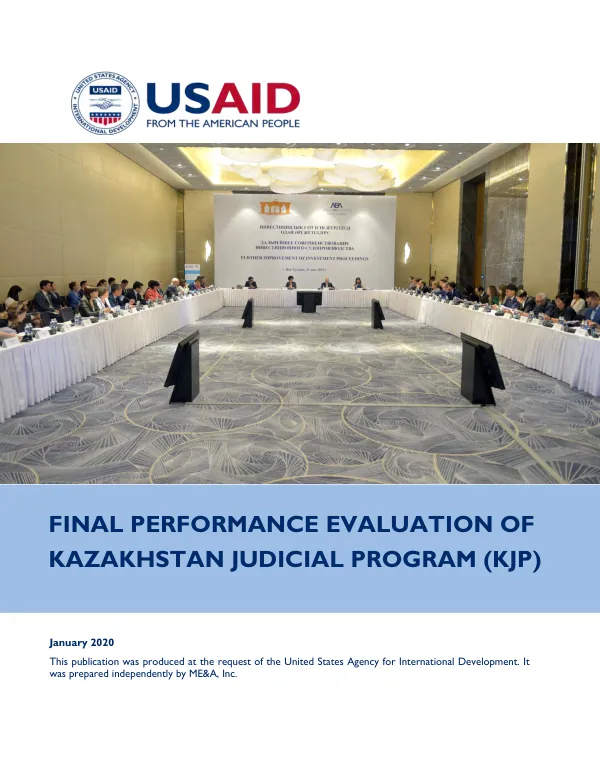
Final performance evaluation of Kazakhstan judicial program (KJP)
The final evaluation of the United States Agency for International Development Central Asia (USAID/Central Asia) Kazakhstan Judicial Program (KJP), implemented by the American Bar Association/Rule of Law Initiative (ABA/ROLI), aimed to: 1) measure project success and identify any remaining gaps, 2) analyze monitoring and evaluation (M&E) systems and identify any issues with progress reporting, and 3) provide recommendations on future USAID interventions to increase public trust in Kazakhstan’s judicial system.
Gjoni, Roland; Yergalieva, Nazgul · 2020
Sign in to readA free account is required to download.
Abstract
The evaluation team (ET) used a mixed-methods approach including desk review of project reports and sector literature, key informant interviews and focus group discussions, and quantitative and qualitative analysis of KJP’s M&E system. KJP met its objectives by improving judicial decision writing capacity and enhancing court efficiency and accessibility. Facing limited support for judicial independence and accountability, KJP focused its assistance and resources on other areas. KJP’s interventions to increase Academy of Justice (AOJ) capacity had limited success due to institutional weaknesses and leadership changes. KJP worked to improve its M&E system to capture and report progress; however, most progress indicators relied on quantitative aspects (i.e., number of events, participants, trainings, materials distributed) rather than measuring the project’s effects and contribution. USAID should continue to support: 1) public trust in the judicial system, by working with stakeholders to strengthen judicial independence and accountability systems, further modernize the courts, and improve judicial education; and 2) public demand for a transparent, independent, and accountable judiciary, by helping civil society organizations increase monitoring and reporting capacity through evidence-based policy research and advocacy efforts
Related documents
![USAID/Bangladesh promoting peace and justice (PPJ) activity mid-term performance evaluation [public version]](https://covers.devme.ai/gen/244.webp)