USAID DEC
Final Performance Evaluation of the Public-Private Partnership Development Program in Ukraine (P3DP)
Sign inFAMILY HEALTH INTERNATIONAL 360
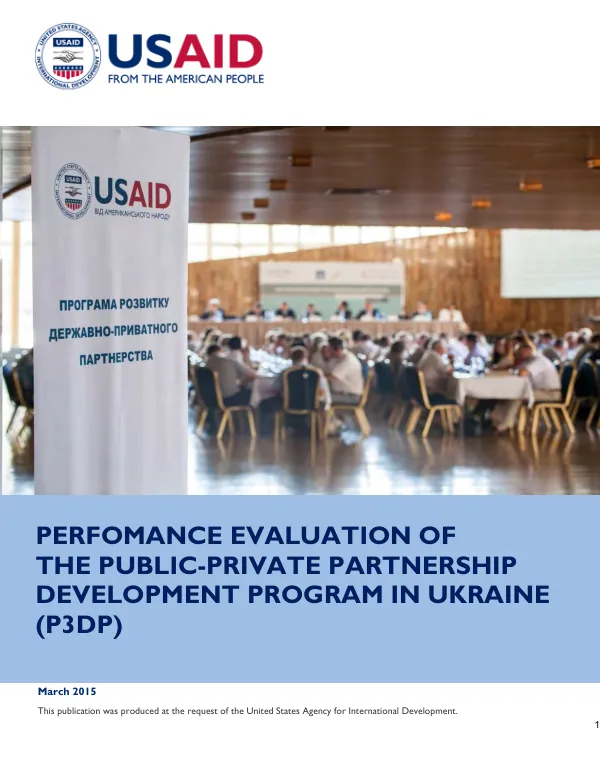
Final Performance Evaluation of the Public-Private Partnership Development Program in Ukraine (P3DP)
The Public-Private Partnership Development Program in Ukraine (P3DP) was a five-year initiative implemented by Family Health International 360 (FHI360) from October 2010 to September 2015.
2015 · 287 pages
Sign in to readA free account is required to download.
Abstract
The program was funded by the United States Agency for International Development (USAID) Mission in Ukraine. The primary objective of P3DP was to support the development of public-private partnerships (PPPs) in Ukraine, with a focus on improving the country's infrastructure and promoting economic growth. P3DP's key interventions included providing technical assistance to the Government of Ukraine, building the capacity of local stakeholders, and promoting the use of PPPs in various sectors. The program also established a PPP development center to provide training and support to potential PPP project developers. Additionally, P3DP facilitated the development of PPP projects in several sectors, including transportation, energy, and healthcare. The evaluation of P3DP was conducted by a team of experts led by Dr. Olga Kaganova and Ms. Katerina Stolyarenko. The evaluation aimed to assess the program's performance against its objectives, identify best practices, and provide recommendations for future improvements. The evaluation methodology included a review of program documents, interviews with key stakeholders, and focus group discussions with local experts. The evaluation found that P3DP had made significant contributions to the development of PPPs in Ukraine. The program had helped to build the capacity of local stakeholders, including government officials, private sector companies, and civil society organizations. P3DP had also facilitated the development of several PPP projects, including a major transportation project in Kyiv and a healthcare project in the Autonomous Republic of Crimea. However, the evaluation also identified several challenges and limitations faced by P3DP. These included the lack of a clear regulatory framework for PPPs in Ukraine, limited access to financing for PPP projects, and inadequate capacity among local stakeholders to manage PPP projects. The evaluation recommended that future programs should focus on addressing these challenges and building on the successes of P3DP. The evaluation also highlighted the importance of PPPs in promoting economic growth and improving infrastructure in Ukraine. PPPs can provide a sustainable source of funding for infrastructure projects, reduce the financial burden on the government, and promote private sector participation in the economy. However, the success of PPPs depends on the presence of a favorable regulatory framework, adequate capacity among local stakeholders, and a clear understanding of the benefits and risks associated with PPPs. In conclusion, the evaluation of P3DP found that the program had made significant contributions to the development of PPPs in Ukraine. However, the program faced several challenges and limitations, including the lack of a clear regulatory framework and limited access to financing. The evaluation recommended that future programs should focus on addressing these challenges and building on the successes of P3DP.
Related documents