USAID DEC
Final Performance Evaluation of the USAID/Philippines Microenterprise Access to Banking Services Program
Sign inDEVELOPMENT AND TRAINING SERVICES, INC.
Final Performance Evaluation of the USAID/Philippines Microenterprise Access to Banking Services Program
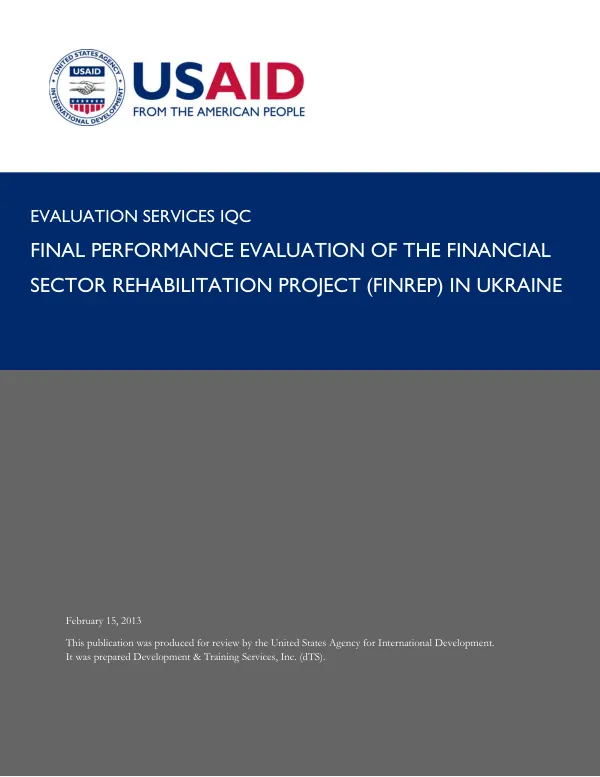
The Financial Sector Rehabilitation Project (FINREP) in Ukraine aimed to assist the country in building a sound, transparent, and resilient financial system.
2013 · 105 pages
Sign in to readA free account is required to download.
Abstract
The project responded to the challenges posed by the global financial crisis to Ukraine's financial markets and economy. FINREP began in October 2009 and was scheduled to be completed in October 2012. The project provided substantial input in reforming the regulatory environment in Ukraine. FINREP assisted in the reform of financial sector legislation and regulations through analytical studies, legal drafting, and monitoring and commenting on legislation. In some cases, the project took a prominent role in developing and drafting legal-regulatory instruments. Ukrainian counterparts in government and the banking sector appreciated FINREP's outreach, responsiveness, and technical input. However, the project did not always succeed in convincing policymakers to follow its recommendations. Despite this, FINREP helped shape the discussion, establish important benchmarks, and persuade some key people of the merits of best practice approaches to financial sector reform. The project appears to have exercised a moderate positive influence on the financial sector policy environment. The project's capacity-building mandate was broadened to include work with regulators, sector associations, and others. The assistance covered a range of regulatory fields, with substantial and well-received support for the implementation of International Financial Reporting Standards (IFRS). Aggregate data show that neither FINREP nor any other participant in the sector was able to counteract the negative trajectory of Ukraine's financial sector since the crisis. However, FINREP chipped away at a number of policy and capacity problems in ways that appear reasonably calculated to improve the situation or, at least, keep it from worsening. The project's performance metrics were not always met, with many considered unrealistic in the context and time frame. The evaluation team recommends that future projects aim for a tighter fit among project objectives, performance metrics, time horizon, and realities on the ground, including available resources and political context. The project's implementation process was assessed through document review, key informant interviews, and small-scale surveys of project participants. The evaluation team consisted of Team Leader Patrick Meagher, Evaluation Specialist Oleksandr Rohozynsky, and Development Specialist Iaroslav Gregirchak. The team's findings, conclusions, and recommendations are presented in response to the questions posed in the Task Order. The evaluation team identified several areas for improvement, including the need for a more realistic approach to project objectives and performance metrics. The team also recommended that future projects prioritize building the capacity of Ukrainian financial sector institutions to implement reforms and raise performance to international best practices. The project's impact on the capacity of Ukrainian financial sector institutions to implement reforms and raise performance to international best practices was assessed. The evaluation team found that the project's assistance in implementing IFRS was well-received and had a positive impact on the sector. However, the project's overall impact on the sector's capacity to implement reforms and raise performance was limited. The evaluation team's recommendations aim to improve the project's effectiveness and impact in the future. The team's findings and conclusions provide valuable insights into the project's strengths and weaknesses, and highlight areas for improvement. The recommendations are intended to inform future projects and improve their effectiveness in achieving their objectives.
Related documents