USAID DEC
Final program performance report : pediatric oncology outreach to Hungary (POOH) -- contract no. EUR-0037-G-00-1078-00
Sign inNATIONAL INSTITUTE OF NEUROSURGERY
Final program performance report : pediatric oncology outreach to Hungary (POOH) -- contract no. EUR-0037-G-00-1078-00
Final contractor report of a grant (9/91-3/97) provided the University of Kansas Medical Center (KUMC) under the Partnerships in Health Care Initiatives Project to implement the Pediatric Oncology Outreach to Hungary (POOH) project in collaboration with two Hungarian institutions -- the Second Department of Pediatrics of the Semmelweis University Medical School (SDP) and the National Institute of Neurosurgery (NINS).
Holmes, Frederick F. · 1997
Sign in to readA free account is required to download.
Abstract
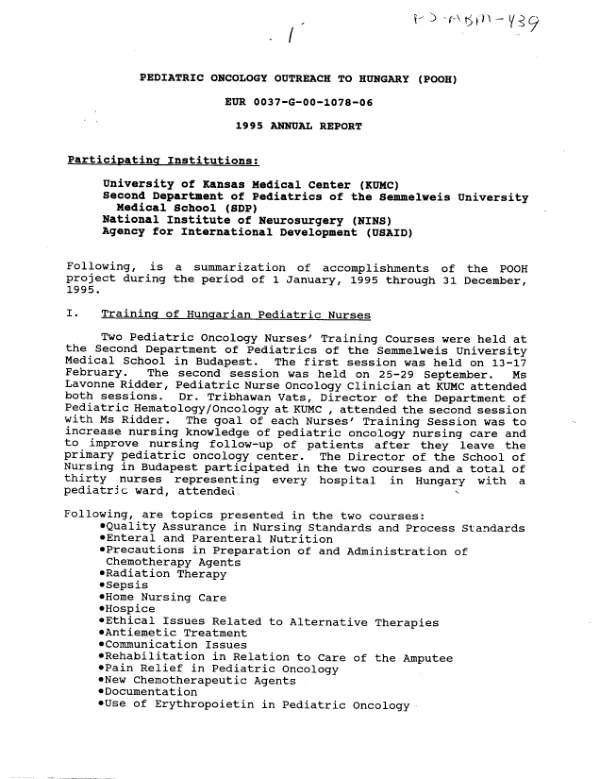
The project was a success. Achievements included: (1) creating a statistical unit for registration of diagnosis, treatment, and survival which will organize and improve long-term patient follow-up; (2) training a cadre of pediatric oncology nurse-clinicians via formal training at KUMC and in-country nurses" training workshops; (3) establishing a multidisciplinary approach as the norm for care of children with cancer; (4) implementing contemporary diagnostic and treatment protocols; (5) upgrading capabilities at SDP and NINS by providing equipment and materials; and (6) improving access to current medical literature. During the project"s final 2 years, knowledge gained during the first 3 was disseminated to as many Hungarian and East European physicians and hospitals as possible. The ultimate proof of the success of this venture was to be improvement in survival for pediatric cancer patients in Hungary as compared with the world standard. Using the actuarial survival program, which is a part of the POOH Pediatric Tumor Registry, survival for (1) all coded tumors, (2) all leukemias, and (3) all central nervous system tumors was computed for NINS and SDP, compared with KUMC. The intervals of 10, 30, and 60 months were chosen arbitrarily to represent the entire course of the grant. The pediatric cancer survival rate for the years 1991-1995 was as follows: the 10-month survival rate was comparable in Hungary and Kansas; the 30-month survival rate is catching up; and at 60 months the gap is still wide. Considering that this project was for 60 months, this is a striking improvement.
![Report on the casemapping education project for Hungarian hospitals (project no. 180-0038.85) [: final report]](https://covers.devme.ai/gen/37553.webp)