INTERNATIONAL BUSINESS AND TECHNICAL CONSULTANTS, INC.
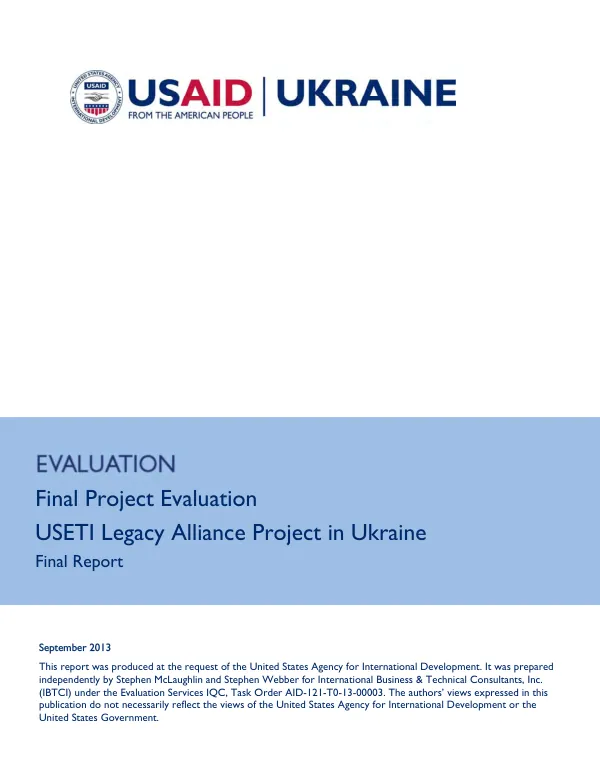
Final Project Evaluation USETI Legacy Alliance Project in Ukraine Final Report
The USETI Legacy Alliance Project in Ukraine aimed to establish a system of testing-based higher education institution admissions that is institutionally secured and self-sustainable.
2013 · 69 pages
Sign in to readA free account is required to download.
Abstract
The project began in 2011 and concluded in 2013. Initial assessments identified the need for a testing system to ensure quality and fairness in higher education admissions. Implementation focused on several key activities, including the development of test items and banking, capacity development for educators and students, and the establishment of a legislative basis for independent testing. The project also aimed to strengthen public demand and government commitment for a sustainable testing system. This was achieved through public awareness campaigns, stakeholder engagement, and policy dialogue. The project's evaluation methodology involved a combination of desk reviews, interviews, and surveys. The evaluation aimed to assess the project's progress towards achieving its stated objectives, including the development of a testing system, strengthening public demand and government commitment, and building stakeholder support. The evaluation found that the project made significant progress in developing a testing system, with the establishment of a test development function and the development of test items. However, the project faced challenges in addressing corruption and cheating, as well as deficits in test development capacity. The evaluation also noted that the project's efforts to engage employers and build stakeholder support were successful, with the establishment of an employer forum and the development of career centers and visiting lecture series in universities. The project's impact on gender issues was also assessed, with the evaluation finding that the project made efforts to integrate gender analysis into its activities and to enhance women's participation in project activities. However, the evaluation noted that the project faced challenges in addressing bias prevention in test development and in engaging men and women equally in project activities. The project also attracted non-USAID resources for funding, including contributions from the Ukrainian government and private sector organizations. The evaluation noted that these resources provided new opportunities for project implementation and sustainability. Overall, the USETI Legacy Alliance Project in Ukraine made significant progress in developing a testing system and strengthening public demand and government commitment. However, the project faced challenges in addressing corruption and cheating, as well as deficits in test development capacity. The project's impact on gender issues was also assessed, with the evaluation noting efforts to integrate gender analysis and enhance women's participation. The project's legacy continues to be felt in Ukraine, with the establishment of a testing system and the development of a legislative basis for independent testing. The project's success in engaging employers and building stakeholder support also provides a model for future projects in the region.