ACADEMY FOR EDUCATIONAL DEVELOPMENT, INC. (AED)
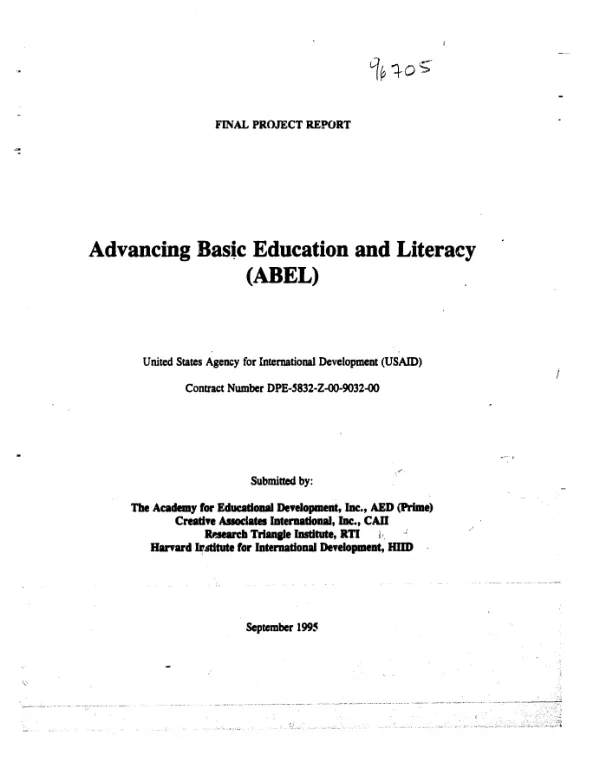
Final project report : advancing basic education and literacy (ABEL)
Final report (9/89-94) by the contractor (the Academy for Educational Development) of the Advancing Basic Education and Literacy (ABEL I) project to improve LDC capacity to deliver basic education.
1995
Sign in to readA free account is required to download.
Abstract
ABEL I directly served 21 countries (12 of which were in Africa) and, including conferences, was active in 23 countries; disseminated information to an additional 50 countries; and directly benefitted approximately 10 million school-age children. This extensive summary of the project includes the following sections: (1) a review of project activities and achievements in (a) technical and managerial support for governments and Missions, including Mali, South Africa, and Malawi, and for USAID Washington; (b) dissemination products, including FORUM, the information bulletin series, country reports, and audiovisual materials; (c) educational planning models (i.e., EPICS, the South African Family of Models, Ethiopia Financial Simulation and Policy Dialogue, and DESAFIO); (d) data bases, including SHARE, SARA-Library, ABEL In-Magic, and ABEL I operational data bases; (e) Policy Dialogue support; (f) research and women in development; (g) conferences, workshops, and training; (h) the development of synergies among ABEL I, other USAID projects, and local groups assisting the Missions; (2) descriptions of Mission buy-ins from 13 countries representing 60% of project expenditures, of regional or central bureau buy-ins to WID and to the Near East and Africa Bureaus, and of core-funded separate contributions to Chile, Thailand, Swaziland, and Venezuela; and (3) a discussion of project management, focusing on communications/reporting mechanisms, service orientation, and special issues. The report includes 15 exhibits and an appendix which includes supporting documentation. Generally, ABEL I met all of its objectives and deliverables and fulfilled all project amendments and delivery orders, and in some cases expanded on requirements to accommodate country demands and conditions, still within the scope of the contract. The project is widely acknowledged as having been a fast-response, thorough, and high-quality central project. In some cases, Missions felt that there were considerable synergies from having a continuous project focused on basic education. Major programmatic breakthroughs were made in the areas of Policy Dialogue and modeling, introduction of women in development in major new projects, new dissemination techniques involving publications like FORUM, and new techniques to involve local groups. A total of 24 lessons learned in the areas of policy dialogue, women in development, implementation issues, training, management information systems (MIS), and administration, are included.