LOUIS BERGER INTERNATIONAL, INC. (LBII)
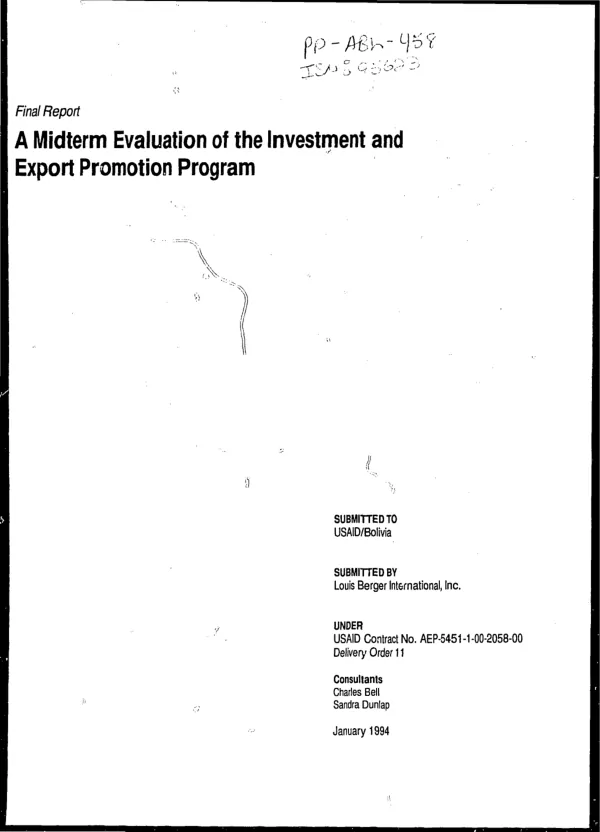
Final report : a midterm evaluation of the investment and export promotion program
Evaluates a program to foster exports and foreign investment in Bolivia.
1993
Sign in to readA free account is required to download.
Abstract
Midterm evaluation covers the period 1989-1/94. The program has been effective in promoting Bolivian exports, especially the nontraditional exports (NTEs) on which it has focused, and, to a lesser but still significant degree, foreign investment. During the period 1990-1993, the project helped develop more than $40 million in exports, or about 10% of the national total for NTEs. The project has also generated more than $17 million in foreign investment in areas in which Bolivia previously had little or no foreign investment. Economic data support the claim that the program has benefitted the Bolivian poor. There are also anecdotal data and survey results indicating that both investment and export promotion efforts are having a favorable impact on employment and incomes. The success of the program can be attributed to flexibility in project management and to strong business acumen on the part of the staff. The contractor and USAID/B have successfully redefined project objectives, reallocated project resources, and retargeted markets and sectors in order to maximize export and investment results. For example, rather than targeting the United States and Europe for exports and investment as originally planned, the project capitalized on the opening of regional markets to increase intra-regional trade by opening offices in Argentina, Peru, Brazil, and Chile. The contractor has demonstrated a strong business sense in picking companies and business persons that will perform, while USAID/B has given the contractor the needed flexibility to pick its beneficiaries and generate exports and investments. Project achievements have not been without tradeoffs, however. Combining export with investment promotion, while giving the program great flexibility and market access, has diffused the efforts of the contractor's overseas offices, and it is not likely that the project will achieve its target of $50 million in investments. In another potential trouble area, an effective balance has been struck between helping larger, already-exporting firms find new markets and providing intensive production and marketing TA to smaller, export-ready firms. It is crucial to maintain this balance, since assistance to larger firms generates good results, while assistance to small/medium firms has more of a transforming effect on production, management, and marketing processes. The program has also been effective in developing sustainable exporting firms. However, with no institutional home and uncertain government support, the program faces the prospect of terminating its activities in 1995, when USAID assistance is likely to end, just as it reaches the top of its operational learning curve. Results to date support the argument to continue, in a reduced manner if need be, both the overseas offices and production-oriented TA. Several lessons have been learned. (1) Changing markets and regional trends demand flexibility in the design and implementation of investment and export promotion projects. (2) The strong trading and business background of program staff has enabled the project to follow a case-by-case targeting of viable companies and obtain quick results. (3) Focusing on results and on developing sustainable exporting companies, while a successful strategy, makes it difficult, if not impossible, to sustain the program after USAID funding is terminated. (4) The highly subsidized nature of the program's export promotion services affects the credibility of the compliments heaped on these services by program clients.
Related documents
Documents in this collection
 1994
1994USAID DEC
Final evaluation : Fundacion de Inversiones y Desarrollo de Exportaciones (FIDE) (export development and investment promotion activities)
Open record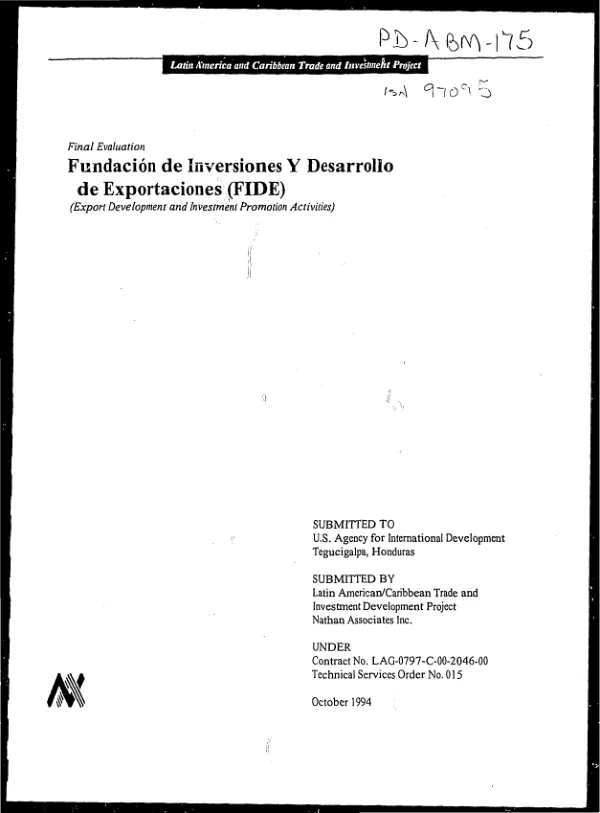 1994
1994USAID DEC
![Plan International : credit/MED [credit and microenterprise development] institutional strengthening initiative -- mid-term evaluation](https://covers.devme.ai/gen/5603.webp)