USAID DEC
FINAL REPORT AND EVALUATION OF NUTRITION EDUCATION PROJECT; CATHOLIC RELIEF SERVICES/MOROCCO; GRANT NUMBER : AID/NESA-G-1169
Sign inCATHOLIC RELIEF SERVICES (CRS)
FINAL REPORT AND EVALUATION OF NUTRITION EDUCATION PROJECT; CATHOLIC RELIEF SERVICES/MOROCCO; GRANT NUMBER : AID/NESA-G-1169
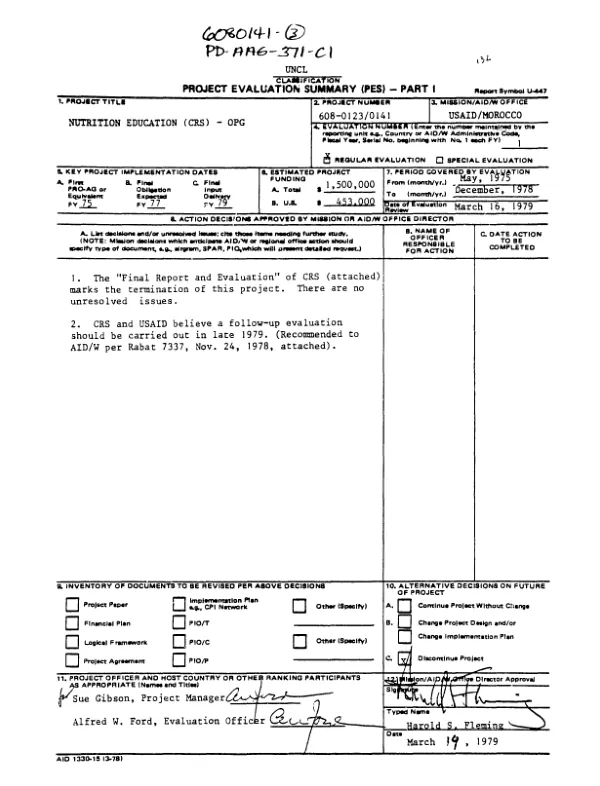
Evaluates the Nutrition Education Project in Morocco from 5/1/75-12/1/78.
1979
Sign in to readA free account is required to download.
Abstract
Project consists of an operational program grant to Catholic Relief Services to assist in establishing a basic nutrition education program in 250 social eduction centers (SEC's), reaching 125,000 mothers with children of preschool age. To evaluate program effectiveness, a baseline nutritional survey was conducted in 1975 of mothers at 26 SEC's. A questionnaire was administered and preschool-age children were weighed and measured. Survey participants were followed throughout the project period. A final survey was made in Spring 1978. (Survey results are amended to this report). Comparisons show a significant improvement in child feeding and practices. Figures indicate that mothers have accepted and implemented what they have been taught. Long-term training for four Moroccan counterparts and short-term training for 26 Provincial Directresses at the National Institute of Nutrition in Tunis was accomplished as scheduled. Five hundred instructors have been trained through in-country seminars. Thirteen lesson plans for mothers' classes and course curriculum for the 4-week in-country seminars were prepared by the fall of 1975. Both were further refined. (Mothers' lesson plans are attached to PES). Enrolled in the program were 125,000 mothers. At each monthly lesson, each mother received a supplementary PL 480 Title II food ration. As an experiment, 11 mothers' clubs were organized which provided nutrition education but no Title II foods. Weekly lessons included demonstrations using local food, family hygiene, and sewing. The fact that 6 of these clubs are still in existance is evidence that this concept can succeed. These clubs are more popular among women on a higher economic level who can afford to contribute their share of food, thread, and other materials. A basic lesson of the project is that poorly educated women (i.e., those without a secondary school education) can be trained (in seminars) to teach basic nutrition and health concepts. In the future, nutrition education should concentrate even more on the worst cases of malnourishment.
Related documents