SHELADIA ASSOCIATES, INC.
Final report : Barangay water program II
Final contractor report on a project (1981-86) to extend water supply services to rural villages (barangays) in the Philippines.
1986
Sign in to readA free account is required to download.
Abstract
The project, despite encountering several problems, has funded over 750 subprojects (SP"s), providing water supply services to approximately 530,000 people at a cost of 293 million pesos; another 339 SP"s, to be completed soon, will extend service to 450,000 more people. Project facilities will have the ultimate capacity to serve a population of 1.5 million. In addition, about 100 test wells have been drilled, 85 local government units have benefitted from TA, and barangay meetings have resulted in the formation of 366 Rural Waterworks and Sanitation Associations (RWSA"s), 234 of which have registered with the Rural Waterworks Development Corporation. Unfortunately, the project is currently in serious disarray. Several SP"s have been suspended, in part because contractors are aware that completion of all facilities would push the total cost of the project above the authorized loan amount. Funding uncertainties have also been exacerbated by USAID/P"s decision to reduce its contribution to the project by $5.5 million in 1985. Timely completion of these SP"s is crucial to project success. The project has also experienced problems with poor management, erratic funding, equipment shortages, unexpected increases in electricity costs, and inadequate training. Contractor recommendations address these problems, and urge that geologists/hydrogeologists have control over all aspects of water wells, that the maximum possible water fee be explained to the consumers as soon as possible, and that the use of microcomputers and nonconventional energy be encouraged. The report includes 20 lessons learned, among them: (1) SP"s that failed usually did so because of either ill-advised attempts to economize on construction materials and equipment, inadequate investigation of water sources, or politicization of the site selection process; (2) too many training sessions ended in futility because participants were not exposed to them long enough; (3) most maintenance work is beyond the financial and technical capabilities of the RWSA"s; (4) the chances of recovering even a small portion of capital costs through user fees are slim; and (5) successful SP implementation and operation can lead to new problems, e.g., larger-than-anticipated increases in demand. Other lessons relate to problems with administrative structure, quality control, construction supervision, geologic conditions, personnel capabilities, and the project"s piecemeal approach to expatriate TA.
Related documents
Documents in this collection
 2018
2018USAID DEC
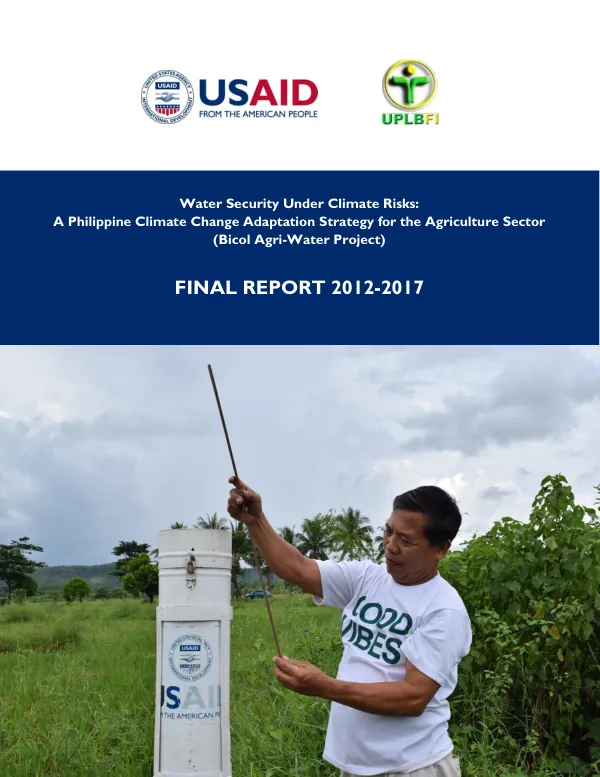
Water security under climate risks : a Philippine climate change adaptation strategy for the agriculture sector(bicol agri-water project) : final report, 2012 - 2017
Open record2013
USAID DEC