CHAD. MINISTRY OF AGRICULTURE. CROP PROTECTION SERVICE
Final report : Chad rodent control research project -- October 1989-December 1992
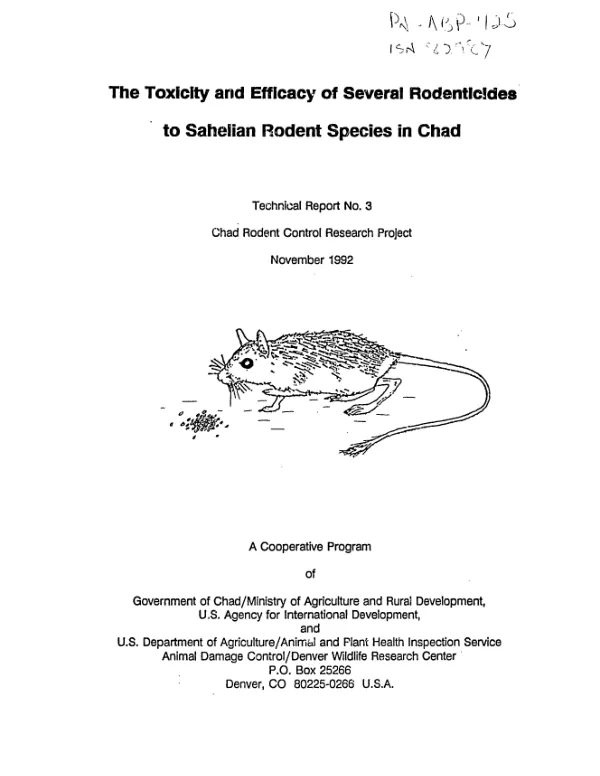
Six rodent species were identified as important pests of dune-grown millet and winter-grown vegetables at N"Gouri and Karal: the lesser hairy-footed gerbil Gerbillus gerbillus, slender gerbil Taterillus sp., robust gerbil Tatera robusta, Egyptian jerboa Jaculus jaculus, Nile or unstriped grass rat Arvicanthis niloticus, and multimammate rat Mastomys (Praomys) natalensis.
Brooks, Joe E. · 1993
Sign in to readA free account is required to download.
Abstract
The unstriped grass rat and the multimammate rat are the primary pest rodents living in irrigated and recessional crop areas. The primary pests on dunes are the lesser hairy-footed gerbil and the Egyptian jerboa, which dig up, eat, and store millet and sorghum seeds at the time of planting. All species respond to the greening and maturation of weeds and grasses during and following the rainy seasons by intense breeding. Rodent population peaks are reached from October until December, depending upon the length of the breeding season. Populations then decline until July or August, when the next breeding season begins. Food preference studies disclosed that most Chadian rodents preferred millet over four other cereal grains, making it the best bait, with rice and wheat as good alternatives. Zinc phosphide at 1% concentration was a good poison, giving excellent results against wadi rodents and fair results against rodents on dunes. Chlorophacinone and bromadiolone at 0.005% would be good alternative toxicants for field use. Training and training materials were developed for crop protection personnel, and two seminars/workshops were presented in Chad. A training manual was developed in both English and French and will be distributed to Sahelian Ministries of Agriculture. Fourteen issues of "Rat Facts", a one-page informational sheet in both English and French, were prepared and distributed to personnel in Chad"s Ministry of Agriculture, AID/N"Djamena, and TA personnel from the Denver Wildlife Research Center. (Author abstract)
![Recherches et la lutte contre les rongeurs : manual de la formation [in English]](https://covers.devme.ai/gen/14340.webp)