USAID DEC
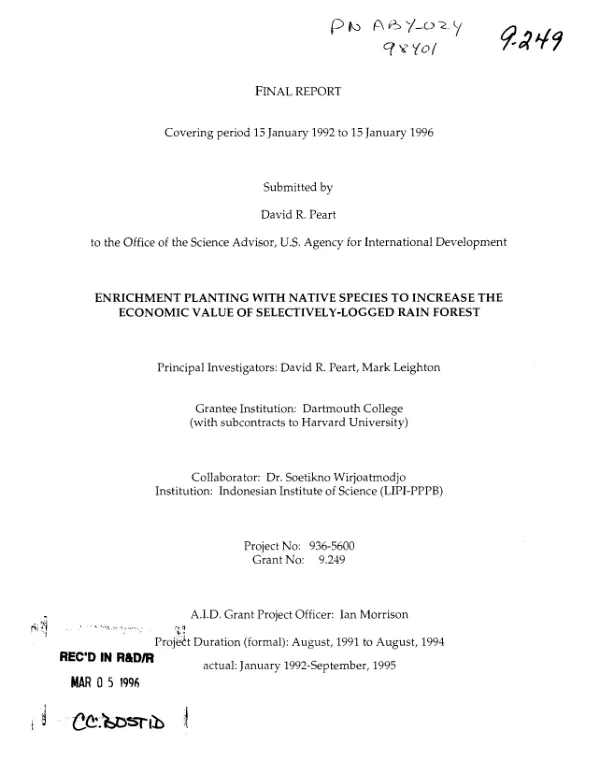
Final report covering period 15 January 1992 to 15 January 1996 : enrichment planting with native species to increase the economic value of selectively-logged rain forest
Sign inDARTMOUTH COLLEGE
Final report covering period 15 January 1992 to 15 January 1996 : enrichment planting with native species to increase the economic value of selectively-logged rain forest
Reports on research to support enrichment planting with native species to increase the economic value of selectively logged rain forests areas in West Kalimantan, Indonesia.
Peart, David R.; Leighton, Mark +1 more · 1970
Sign in to readA free account is required to download.
Abstract
The main factors leading to rain forest clearance by native Dayak villagers are apparently socioeconomic and political: the need for a cash crop (rubber) and the desire to "claim" land to stave off the perceived threat of conversion of natural forest to oil palm plantations. Currently, shifting cultivation by Dayak villagers affects a much smaller area of forest than either commercial logging or conversion to plantations. Commercial selective logging results in heavy damage to 70% of the rain forest canopy. Nevertheless, logged sites retain a high species diversity and contain patches of relatively undisturbed forest (especially in swampy sites), and contain residual resources for wildlife populations and local villagers. Some native tree species have high potential for enrichment planting. In particular, punah (genus Tetramerista) grows rapidly, has abundant natural regeneration, and transplants extremely well in disturbed conditions. Diallium and Sindora also have potential for development for timber (both species) and for fruit (diallium). Economic and ecological assessment of gaharu (Aquilaria), the most valuable tree in the region, also indicates long-term management potential. Studies of spatial distribution, habitat preference, and herbivore damage on dipterocarp seedlings provide information for ecologically sound management of dipterocarp timber populations. There appears to be great potential for quantitative integration of rigorous ecological and economic assessments of forest management projects. This interdisciplinary approach to developing innovative methods of exploiting natural productivity sustainably and profitably is recommended. The research findings have been reported in 20 research papers, manuscripts and reports, which have been distributed in Indonesia. Training of Indonesians was a high priority. University faculty, thesis students and conservation (PHPA) professionals attended training courses in tropical tree dendrology and herbarium techniques. Four long-term research students spent 4-6 months on site and published four papers and reports, and several sarjana (thesis) students were jointly directed by project staff and Indonesian faculty advisors. Collaborators included university faculty and scientists from the Ministry of Forestry and an NGO, who have authored or co-authored three papers and manuscripts. (Author abstract)

![Final report : PSTC [program in science and technology cooperation] project no. 9.396 -- `high density techniques in palm heart production"](https://covers.devme.ai/gen/16464.webp)