USAID DEC
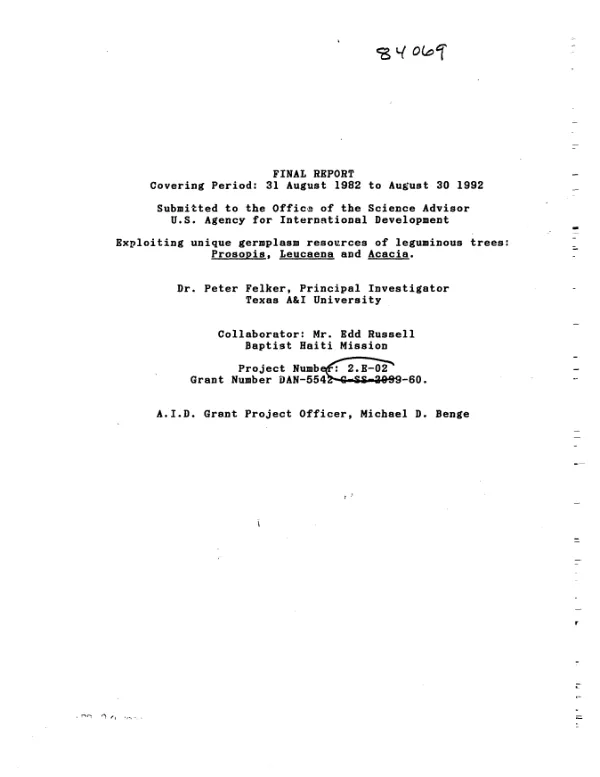
Final report covering period : 31 August 1982 to August 30, 1992 -- exploiting unique germplasm resources of leguminous trees : Prosopis, Leucaena and Acacia
Sign inBAPTIST HAITI MISSION
Final report covering period : 31 August 1982 to August 30, 1992 -- exploiting unique germplasm resources of leguminous trees : Prosopis, Leucaena and Acacia
In Haiti, and other semiarid regions of the world, the need for fuelwood and forage is critical.
Felker, Peter; Russell, Edd · 1970
Sign in to readA free account is required to download.
Abstract
This report summarizes research conducted over a 10-year period on developing replicable plantations of leguminous trees in semiarid lands, especially in areas near seawater salinity levels. Research included greenhouse and laboratory work followed by field trials in Haiti and focused on two species: Prosopis and Leucaena. (Acacia is mentioned in the report"s title but not in the report itself.) Results were as follows. (1) Greenhouse experiments identified leaf diagnostic criteria indicating mineral nutrient deficiencies in field trees. It also established the importance of micronutrients, especially zinc, in permitting growth in high pH (9.0) soils. (2) A most interesting discovery was the identification of Prosopis seedlots capable of growing at 3.2% sodium chloride, which is equivalent to seawater, indicating a potential for seawater irrigation of nitrogen fixing Prosopis along coastal deserts. (3) Tissue culture work was successful with Leucaena but not with Prosopis. (4) A countrywide collection of Prosopis germplasm in Haiti was made and then compared in field trials with Leucaena and Prosopis from the United States, Argentina, Chile, and Peru. Several elite species for use in Haiti were identified, and a solar-powered mist system was developed for their asexual propagation. Unfortunately, transfer of the genetic materials developed under the project is severely hampered by lack of a dissemination mechanism and, more basically, by a wide lack of appreciation for the problems facing semiarid lands.
Related documents