USAID DEC
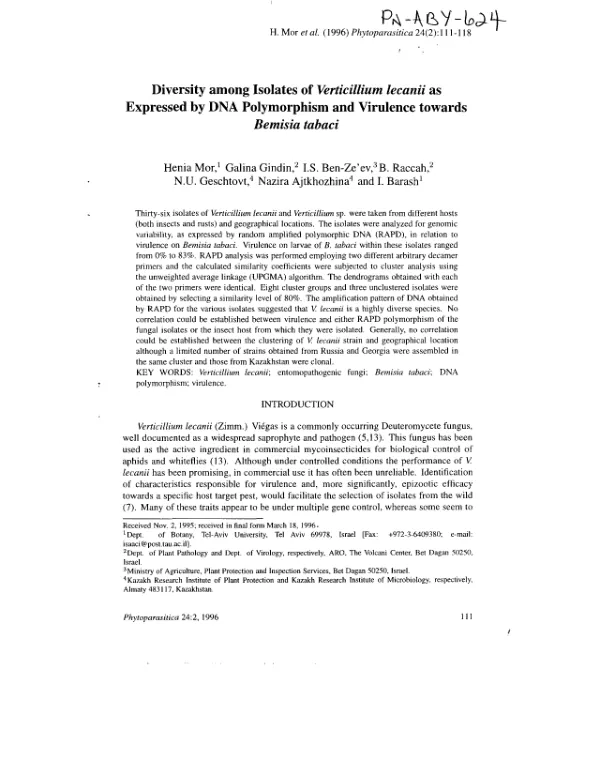
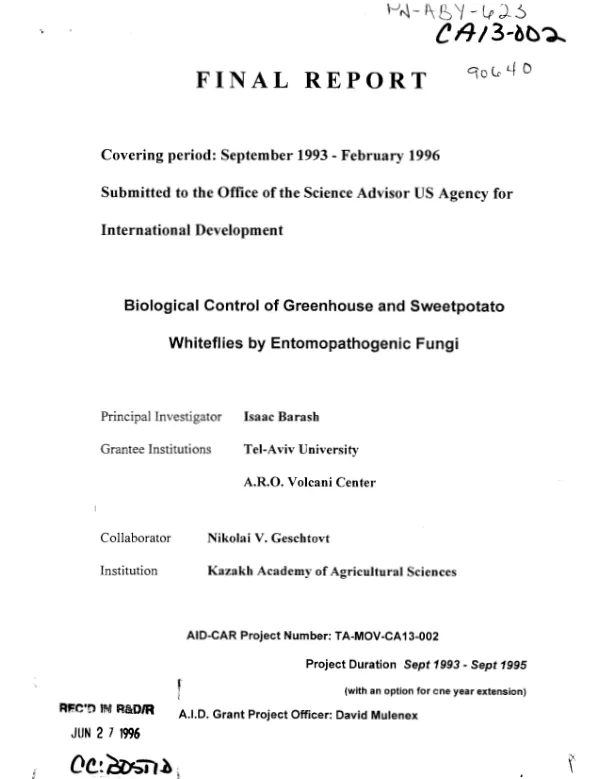
Final report covering period September 1993-February 1996 : biological control of greenhouse and sweetpotato whiteflies by entomopathogenic fungi
Sign inAGRICULTURAL RESEARCH ORGANIZATION. THE VOLCANI CENTER
Final report covering period September 1993-February 1996 : biological control of greenhouse and sweetpotato whiteflies by entomopathogenic fungi
Between September 1993 and February 1996, Tel-Aviv University and A.R.O.
Barash, Isaac; Geschtovt, Nikolai V. · 1996
Sign in to readA free account is required to download.
Abstract
Volcani Center collaborated in a study to develop effective screening procedures for mycoinsectides against whiteflies and employ them for selecting such strains from Verticillium lecanii and Beauveria bassiana; an additional objective was to assess the genetic and phenotype diversity of these fungi in relation to virulence. The study achieved most of its objectives. One hundred strains of the following fungi obtained from various hosts and geographic locations were screened and evaluated for virulence on Bemisia tabaci and Trialeurodes vaporariorum: Verticillium lecanii (35), Beauveria bassiana (15), Paecilomyces fumosoroseus (28), Paecilomyces farinosus (2), Conidiobolus coronatus (2), Conidiobolus spp. (8), Hirsutella sp. (7), and Verticulium sp. (3). Highly efficient virulent strains of either V. lecanii or B. bassiana and an additional, still unidentified, Verticillium-like strain were selected by the procedures developed. All these strains were effective against all stages of the whiteflies with the exception of eggs which were immune. Only very few strains of B. bassiana and the Verticillium-like strain (but not V. lecanii) were effective under high temperatures and low humidity which are common to greenhouses in either Kazakhstan or Israel. The study on genetic diversity of V. lecanii in relation to virulence was summarized in an enclosed paper published in Phytoparasitica. The main contribution of this project to Kazakhstan and Israel is the obtained effective mycoinsecticides strains which can now be employed for biocontrol of whiteflies. Additional general contributions are (a) development of screening procedures under in vivo conditions; (b) identification of the lack of a relationship between genetic diversity or geographic distribution of V. lecanii and virulence; and (c) the emphasis on the need to obtain highly virulent fungal strains which will be adapted to climatic conditions (ecotypes) where they will be employed. The cooperation achieved between the two countries was very good and resulted in this joint publication. (Author abstract)
Related documents