USAID DEC
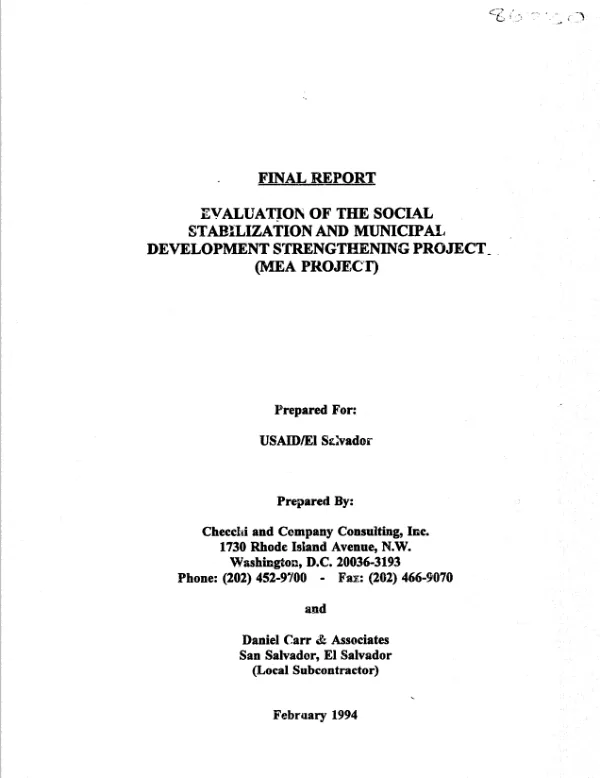
Final report : evaluation of the social stabilization and municipal development strengthening project (MEA project)
Sign inCHECCHI AND CO. CONSULTING, INC. (CCCI)
Final report : evaluation of the social stabilization and municipal development strengthening project (MEA project)
Evaluates the Government of El Salvador's (GOES) A.I.D.-supported Municipalities in Action (MEA) program, which has since 1987 channeled funds to municipal governments in areas of civil conflict for popularly chosen, small-scale reconstruction projects.
Wilson, Patricia Ann|Banks, Duke|Taylor, Lewis · 1994
Sign in to readA free account is required to download.
Abstract
The evaluation involved a random survey of over 1,000 persons in an effort to determine public attitudes about the MEA program, its impacts on the public's perceptions of national and local governments, its contribution to strengthened local government, and its overall contribution to democratization. Arising from the context of civil war, the MEA program has become a vehicle for strengthening local democracy and a cornerstone of the National Reconstruction Program. By 1989, it was active in the entire country, with the exception of 19 northern municipalities controlled by the FMLN. Since 1989, municipal governments have implemented nearly 9,000 projects, primarily in roads, schools, water, and electrification, reaching into remote rural cantons throughout the country. In 1993, MEA projects were implemented in all 261 municipalities of the country (except the capital). The survey showed conclusively that the program has had widespread success in increasing confidence in local government, and, by association, the national government; support for both is higher among those who know of or have attended the cabildos abiertos -- the open town meetings, held by the mayor, at which infrastructure projects are identified or discussed -- or who have benefited from MEA projects. The positive impact of the MEA program on attitudes toward local government has been felt almost as strongly in the ex-conflict zones as in the rest of the country. Most surprisingly, the popular image of the implementing organization, the Secretariat for National Reconstruction (SRN -- formerly CONARA), is quite positive, even in ex-conflict zones, based on its ability to respond to people's needs for infrastructure. Clearly, the program contributes directly to two of USAID's strategic objectives: (1) to help the country make the transition from war to peace by building local level democratic institutions and increasing civic participation; and (2) to promote enduring democratic institutions by strengthening local government and responding to the basic infrastructure needs of the community. Contrary to the findings of two earlier critical reviews (Sollis, 1993, and Yariv and Curtis, 1992), people see the cabildos as a representative forum open to all members of the community and as a genuine expression of the mayor's concern for the community's needs. Nevertheless, people are dissatisfied with the level of participation that the cabildos afford, expressing a desire for involvement beyond the initial project selection and the willingness to contribute more of their own resources if invited to do so. The survey also revealed a major weakness of local government, for, despite the growth in cabildos, people perceive a lack of opportunity for popular participation. The municipal councils are blamed for their practice of frequently holding closed council meetings. Finally, people see community organizations as the most important promoter of their interests and want local government to work more closely with these organizations; further, communities that have legally recognized community organizations show higher confidence in local government than those that do not. Thus, it would be in the mayor's interest to promote and work with such organizations. Lessons learned included the following. (1) Local government is an effective vehicle for prioritizing and implementing multi-sectoral investments. (2) Mayors are willing to collaborate at a regional level to prioritize investments and plan strategically. (3) Public attitudes towards national government are enhanced by improving the image of local government. (4) Organized communities have a more positive attitude towards local government than do unorganized communities; there is a natural bridge waiting to be built between local government and community organizations. (5) People want to participate in local government, and the more they do so, the more willing they are to contribute their own resources and to help maintain projects.
Related documents
Documents in this collection
 1994
1994USAID DEC
Final report : evaluation of the social stabilization and municipal development strengthening project (MEA project)
Open record![Final report : evaluation of the social stabilization and municipal development strengthening project (MEA [municipalities in action] project)](https://covers.devme.ai/gen/36493.webp) 1994
1994USAID DEC
![Final report : evaluation of the social stabilization and municipal development strengthening project (MEA [municipalities in action] project)](https://covers.devme.ai/gen/7516.webp)