THE CLOUDBURST GROUP
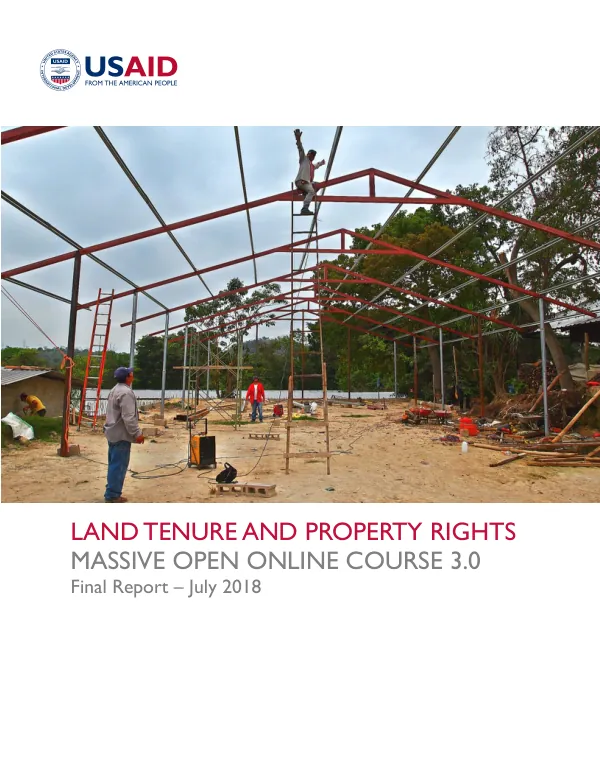
Final Report: Land Tenure and Property Rights Massive Open Online Course 3.0
The Land Tenure and Property Rights Massive Open Online Course 3.0 was designed as an online introduction to the concepts and application of land tenure and property rights for development practitioners and academics around the world.
2018 · 250 pages
Sign in to readA free account is required to download.
Abstract
The course was offered in the spring of 2018 and was hosted on the Canvas Learning Management System. MOOC 3.0 recreated many of the learning experiences and social opportunities of an in-person university course, allowing for a degree of interactivity between students in 110 different countries. The course was modular in format, starting with three prerequisite modules on introductory topics. Once these prerequisites were completed, students could choose from 15 elective modules and three country case study modules. Modules consisted of required and optional reading assignments, video lectures hosted by experts in the field, quizzes, and interactive discussion forums. MOOC 3.0 differed from previous iterations of the course in three key ways: two new elective modules were added, students were given freedom to choose any elective module that interested them, and a new integration with Mailchimp was developed to address challenges in tracking student progress. A total of 1,482 students enrolled in MOOC 3.0. Of these, 690 students (46.6%) completed the mandatory welcome survey at the start of Module 1, and 218 students (31.6% of active participants and 14.7% of total enrollment) met or exceeded course completion requirements and earned a certificate of completion. This compares favorably to the 10% completion rate frequently cited in research on MOOCs. MOOC 3.0 students came from a variety of professional backgrounds, including USAID, USAID implementing partners, the U.S. Government, governments other than the U.S., universities, non-governmental organizations, and the private sector. Student responses to the course were overwhelmingly positive. Of the students that successfully completed the course, the average rating was 4.65 on a scale of one (poor) to five (excellent). Discussion forums consistently contained thoughtful comments from experts in their respective field or region and often included comments from classmates in other parts of the world. The online nature of the course allowed for a topic to be presented to far more students than could ever fit into a classroom. MOOC 3.0 was developed in a modular format with each module containing required reading assignments, optional reading assignments, video lectures, discussion forums, and a quiz. Readings were curated by subject matter experts to provide essential background concepts for that topic. Video lectures were typically 40 to 60 minutes in length and combined footage of the lecturer(s) with graphics, images, maps, PowerPoint slides, and other multimedia. Discussion forums were designed to be platforms for participants to pose questions and ideas, share insights and experiences, and receive input from lecturers. The course included four live, interactive webinars hosted either by course lecturers or USAID staff. These events generally consisted of video presentations followed by question and answer sessions. MOOC students were also required to complete pre- and post-course assessments. The results of the assessments can be found in the appendix. MOOC 3.0 was promoted using a variety of channels, most notably the LandLinks website and email list, social media, and the Canvas course catalog. The course was the most popular event and training page on the LandLinks website during the December 2017-April 2018 time period, receiving 1,155 unique page views.