USAID DEC
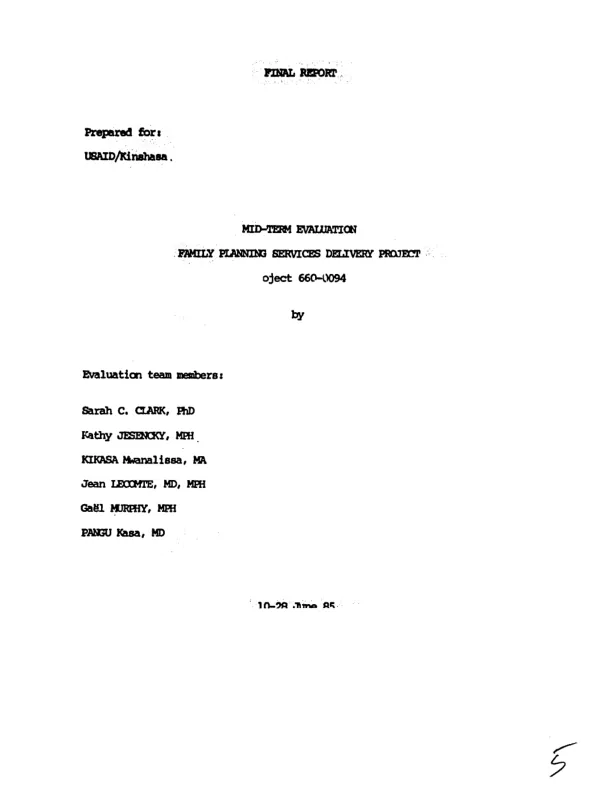
Final report : mid-term evaluation, family planning services delivery project, project 660-0094
Sign inUSAID. MISSION TO ZAIRE
Final report : mid-term evaluation, family planning services delivery project, project 660-0094
Evaluates project to promote contraceptive usage through 75 family planning (FP) units in 14 urban areas of Zaire.
Clark, Sarah C.|Jesencky, Kathy · 1985
Sign in to readA free account is required to download.
Abstract
Special midterm evaluation covers the period 10/82-6/85 and is based on document review, site visits, and interviews with project, USAID/Z, and National Committee for Desired Births (CNND) staff. The project faces several concerns, of which the most serious is probably institutional. Administration and coordination was to have been CNND's responsibility; however, as this proved infeasible, an independent project structure was created. The resulting confusion as to roles and responsibilities has weakened CNND and led to much duplication of effort. It is uncertain whether these two implementing arms possess the good will needed to agree upon formal arrangements for specifying their respective roles. Activities are behind schedule, mostly due to delays in procuring contraceptives and TA. To date, 33 hospitals, clinics, and dispensaries are participating, but not all are fully operational, and contraceptive prevalence at these sites is estimated at less than 1%. Constraints include: failure to prepare communities to receive FP services; the limited number of service sites (some do not collect statistical data, and may or may not provide FP services); eligibility criteria in some cases restricting services to married women; lack of follow-up, resulting in poor continuation rates; and the medical community's failure to integrate FP with health care. Design assumptions as to unmet demand for FP and the availability of informational methods and adequate infrastructure appear unfounded. In other areas, project training is providing a much needed service and is exceeding targets (emphasis, however, has been on developing a basic contraceptive technology curriculum, with little attention to curricula for the nursing and medical schools); supervision of FP sites is not yet routine; and data collection is inconsistent, and there are no national-level consolidation and analysis of FP data. Financial management is good, but numerous personnel issues need attention. Success will depend upon resolving current deficiencies in such a way as to produce a strong and independent CNND with a narrower and more focused program. For key recommendations, see the attached PES (PD-BAX-424).
Related documents
Documents in this collection
 1985
1985USAID DEC
Final report : mid-term evaluation, family planning services delivery project, project 660-0094
Open record![Final report (condensed) -- Zaire : a situation analysis of the family planning program, comparing three service delivery systems [-- Africa operations research and technical assistance project]](https://covers.devme.ai/gen/6089.webp) 1992
1992USAID DEC