USAID DEC
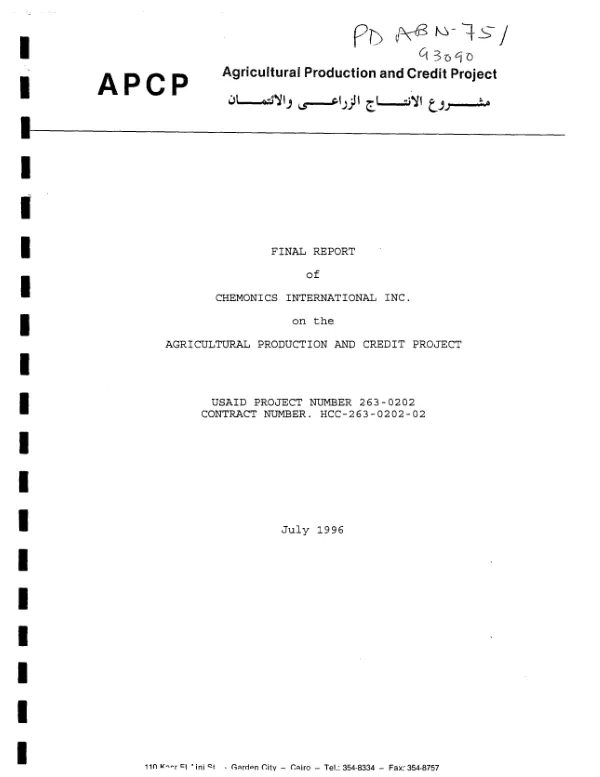
Final report of Chemonics International Inc. on the agricultural production and credit project
Sign inCHEMONICS INTERNATIONAL, INC.
Final report of Chemonics International Inc. on the agricultural production and credit project
Final report of the contractor (Chemonics International, Inc.)
1996
Sign in to readA free account is required to download.
Abstract
on a project (1986-4/96) to (1) promote policy reforms to deregulate Egypt"s agricultural sector, and (2) help the Principal Bank for Development and Agricultural Credit (PBDAC) increase credit to farmers in a deregulated sector. The policy changes made by the Government of Egypt (GOE) have satisfied program benchmarks and dramatically liberalized the agricultural sector -- freeing farmers from area controls and output quotas, liberalizing prices, reducing input and credit subsidies, and resulting in a lessening of restrictions on foreign trade and the opening of trade in farm inputs and outputs to the private sector. Farmers and business people have responded, and Egypt"s markets are opening up. The liberalization of cotton production, ginning, and trade was politically controversial and took several years. The policy reform component also resulted in public dialogue on the benefits of free markets and private investment; two international policy conferences were held in Cairo, resulting in publication of a book summarizing the policy papers presented there. The second component significantly strengthened the PBDAC and its network of provincial-level banks (BDACs) and village-level banks. Numerous special studies helped the banks modernize their organization, personnel management, warehouse and storage management, auditing functions, accounting and fiscal reporting, budgeting, and training programs. A revised Mission Statement was prepared to reflect the Bank"s newly liberalized lending and deposit mobilization, and a nationwide computerized management information system was installed in the PBDAC and the BDACs. In 1993, the Bank began to lend on a creditworthy basis for any rural development activity. By 1995, the majority of the Banks LE 5.6 billion in loans were short- and medium-term investment loans and, except for equipment procurement loans, the Bank had discontinued in-kind lending. By 1996, the Bank"s equity had increased to LE 900 million, enabling it to rely more on its own resources and providing considerably more security for its depositors. Retained earnings from the program"s capital grants have been used by the PBDAC and the BDACs to strengthen training programs, refurbish village and branch banks, and procure needed furnishings and equipment. The PBDAC has financed most of the program"s in-country training and computer terminal installations, and is the only government agency to apply a bonus-driven early retirement program, resulting in a substantial reduction of employees during 1993-1995. In the words of one frequent consultant to the project, "I"ve looked at a lot of agricultural development banks around the world and feel the PBDAC has more growth potential than any of them." Finally, the PBDAC has vigorously supported the highly successful pilot Bank Improvement Program (BIP) (see PD-ABN-748 for a detailed description of this program"s activities) in three governorates (Beni Suef, Gharbiya, and Daqahliya). The PBDAC has also requested a 1-year extension of the current project to facilitate its assumption of the project"s activities (primarily the BIP). The following are lessons learned. (1) The PBDAC must substantially downsize; recent changes in the Bank"s activities have resulted in one- to two-thirds of its 30,000 employees being seriously underemployed or outright redundant. (2) The PBDAC ought to serve new markets, including much more deposit mobilization, more women clients, more owners of non-farm rural businesses, and selling various types of insurance. (3) Historically, most of PBDAC"s leaders have been agriculturalists, not bankers. The Ministry of Finance, along with the Central Bank, views the PBDAC as a quasi-bank and expects it to rebate to them a significant part of its profits each year. These profits will probably decline sharply in the next several years because of lost fertilizer sales. If the BIP is adopted and supported nationwide, it could prove to be the easiest and best path for the PBDAC. (4) For the most part, the PBDAC has ignored non-farm activities. But no distinction should be made between loans to farmers buying fertilizer from a private merchant and loans to merchants, who, in turn, provide the fertilizer on credit to the farmer. (5) To draw political and popular attention to the PBDAC, the Bank might change its name to something like The Rural Bank of Egypt. (6) Serious attention should be given to privatizing the PBDAC or abolishing it and privatizing the BDACS under supervision of the Central Bank. This would put the BDACs on a level playing field with other Egyptian banks.