USAID DEC
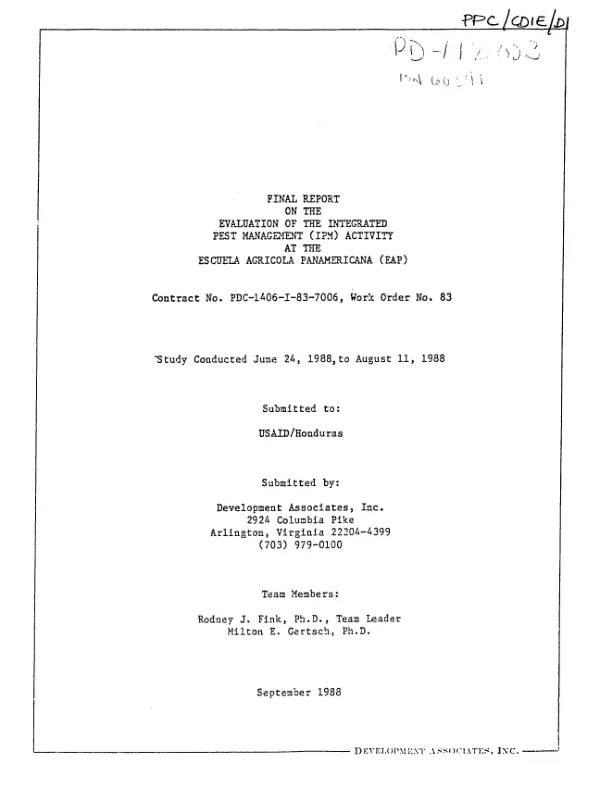
Final report on the evaluation of the integrated pest management (IPM) activity at the Escuela Agricola Panamericana (EAP)
Sign inDEVELOPMENT ASSOCIATES, INC.
Final report on the evaluation of the integrated pest management (IPM) activity at the Escuela Agricola Panamericana (EAP)
Interim evaluation of a project to support an integrated pest management (IPM) program within the Escuela Agricola Panamericana (EAP) in Zamorano, Honduras.
Fink, Rodney J.|Gertsch, Milton E. · 1988
Sign in to readA free account is required to download.
Abstract
The program aims to develop new IPM technologies and test extension procedures and materials for transfering these technologies to trainers and farmers. External evaluation covers the period 1986-9/88. The project is well-managed and meets its teaching, research, and extension mandates. EAP students receive an excellent balance of theoretical and practical training through a curriculum which utilizes a large quantity of project-developed IPM teaching materials, including textbooks, laboratory guides, and audiovisual modules. It is recommended that A.I.D. support continued development and distribution of these materials throughout Central America. Research conducted both on- and off-station is designed to solve the specific production problems of Honduran farmers. In addition, detailed research is conducted to develop delivery methods acceptable to farmers. Farmers are also involved throughout the process of identifying research needs and in developing research and extension methodology. As a result, the EAP's relationship with participating farmers and other cooperators is strong, and farmers are changing their practices. EAP research-extension technologies and methodologies could also serve as models for other crop production technologies. The EAP could make valuable contributions to USAID/H's proposed Land Use and Productivity Enhancement (LUPE) project. In addition to IPM expertise, LUPE would benefit highly from the EAP's research program in no-tillage production and its diagnostic, biological control, and pesticide use and efficacy centers. Should the project become a part of LUPE, it is recommended that the EAP receive $1 million per year for research, extension, and teaching services. The major lesson learned is that plant protection provides easy access to farmers because it usually results in dramatic and positive solutions. IPM activities could serve as the conduit for the flow of other technologies, such as soil testing and fertilization.
Related documents