DEVELOPMENT ALTERNATIVES, INC. (DAI)
Final report on the fiscal administration development project
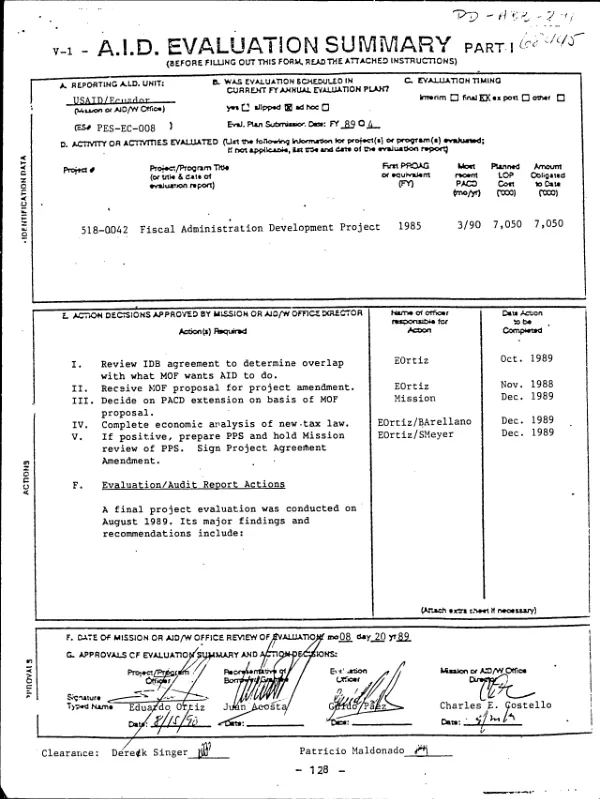
Presents final external evaluation of a project (FY85-8/89) to reform tax administration in Ecuador.
1989
Sign in to readA free account is required to download.
Abstract
The project's design was negotiated with the Febres Cordero administration, which came into power in 8/84; the project began in 8/85. While the project was under a number of serious constraints, since it did not contemplate changes in the tax law (which had serious deficiencies), it was, nevertheless, a well- conceived, comprehensive, and well-planned, if overambitious initiative, which appeared to have the full support of the Minister of Finance (MOF) and the GOE. The background and qualifications of the contractor, OMNIMAX, appeared to be ideal to provide TA in transforming the Direccion General de Rentas (DGR) into a modern tax administration agency. Within 8 months, however, the project ran into a serious problem of wavering MOF support which was to plague it throughout the 4- year period of the Febres Cordero administration. Reorganization of the DGR, which was central to the project, was held up for a year before finally being approved by the MOF (putting the project a year behind schedule). When that problem was resolved, the GOE refused to provide duty-free customs clearance for equipment brought in under the project so that the other central project element -- computerization of tax collections, control, and follow up -- was delayed indefinitely. Although both USAID/E and OMNIMAX worked diligently to resolve this problem, it persisted until the change of government in 8/88. In spite of these problems, OMNIMAX tried to achieve at least some of the project's objectives. Some success was achieved in improving the collections system, and taking the first steps to separate policy from operational functions and to decentralize the system. The greatest failures were in auditing, systems, and processing. This was due to internal resistance to change within the DGR, lack of leadership and confidence at the subdirector level of the DGR, deficient TA from OMNIMAX, and waning commitment on the part of the MOF. The new government, which took office in 8/88, took immediate action on fundamental tax reform, promulgating a new tax law and initiating a lightening-like program of procedural changes. It also addressed some of the project's long-standing problems -- resolving the matter of customs clearance and promptly honoring a project obligation to put 20 collection agents on the DGR payroll. The new government's tax reforms will represent a significant improvement. If they are to succeed, the DGR must be strengthened and reoriented. Recommendations along these lines are presented. (Author abstract, modified)