CHECCHI AND CO. CONSULTING, INC. (CCCI)
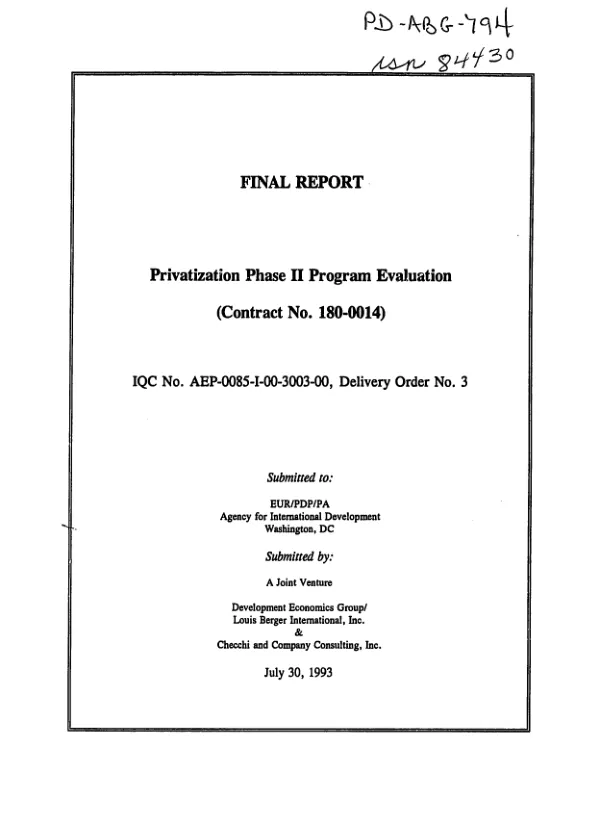
Final report : privatization phase II program evaluation (contract no. 180-0014)
Evaluates 44 activities implemented between mid-91 and 2/93 in the Czech Republic, Poland, and Hungary under the Privatization and Enterprise Restructuring Project at a total cost of more than $31 million, about two-thirds of total project funding.
1993
Sign in to readA free account is required to download.
Abstract
It is estimated that over 70% of the expenditures have resulted in either outright success (52%) or mixed success (20%). The Czech Republic's percentage of successful or mixed success results is 80%, Poland's is 64%, and Hungary's 85%. A.I.D. assistance has led to outright success in the provision of specialized transaction assistance (96%), institutional support (89%), and policy/program support (80%). By contrast, 47% of the firm-specific projects have not been successful, and only 44% of sectoral studies have had enough impact to be considered successful. Some of the more notable successes have included: (1) specialized transactional support to the Czech Ministry of Privatization through Crimson Capital/D&T; (2) assistance to the Mass Privatization Program in Poland; (3) work with the Czech Savings Bank; (4) development of an Employee Sponsored Ownership Plan program in Hungary; (5) financial sector regulation assistance in Poland; and (6) support to the State Property Agency in Hungary. These successful projects either: helped effect or speed up actual privatizations; established financial institutional structures for future privatizations and market development; established operational procedures for future privatizations; achieved concrete economic benefits (e.g., increased purchase prices, investment); or provided unanimous, tangible political benefits such as strong host government appreciation and/or demand for more A.I.D. services. Successful projects: (1) enjoyed strong government and A.I.D. support; (2) were undertaken in the middle of the privatization sequence (e.g., during development of procedures or policy guidelines) or even towards the end when privatization proposals were being implemented; and (3) were focused at the policy/program or institutional support level and at one stage of the privatization process (e.g., transaction negotiations) and rendered to many firms. The following lessons have been learned. (1) Facilitating the privatization process is better than promoting a single privatization transaction. (2) Almost all the long-term advisors have been considered either critical or very useful to privatization programs by government officials and clients. These advisors often develop a strong understanding of the capability of government officials they are supporting, provide continuity when there are changes in Ministry staff, and establish credibility for the government with outside advisors and for A.I.D. with the government. (3) Initiating advice early in a policy/program cycle can create credibility and jumpstart a policy/program, as has occurred several times in Hungary and the Czech Republic. (4) A.I.D. privatization assistance should be focused yet diversified. A.I.D. is especially qualified to supply foreign transaction assistance, but this should not be to the exclusion of rendering domestic privatization support; projects should not emphasize foreign investors for the sake of short-term economic benefits to the neglect of longer term domestic issues such as restructuring and promotion of domestic investment. (5) At times, lack of coordination of contract management between A.I.D./W and the field has impeded project timeliness. Conversations with A.I.D. representatives and A.I.D./W personnel reveal an underlying tension and debate as to which should manage the privatization program. Currently, contract management is centered in A.I.D./W, which has been understaffed, had high turnover, and not always had funds for regular field visits. These constraints, along with fast-changing demands in the field, have led to some disagreements and funding delays which have hurt A.I.D.'s credibility. (6) A decentralized, reactive privatization strategy in which initiatives are defined by government demands and/or marketing efforts of contractors can generate politic support and good will, and can be useful for testing pilot interventions. However, continued application of an ad hoc strategy can dissipate resources, and in the absence of concrete results, weaken political support for a program. Also, having the host government set the rules for project conduct is not always a reliable guide. The evaluation includes guidelines for developing privatization programs in the Southern Tier countries and the Baltics. (Author abstract, modified)
Related documents
Documents in this collection
![Evaluation of the privatization and enterprise restructuring project (contract no. 180-0014)[i.e. project no. 180-0014] : IQC no. AEP-0085-I-00-3003-00, delivery order no. 3 -- draft final report](https://covers.devme.ai/gen/5139.webp) 1993
1993USAID DEC
Evaluation of the privatization and enterprise restructuring project (contract no. 180-0014)[i.e. project no. 180-0014] : IQC no. AEP-0085-I-00-3003-00, delivery order no. 3 -- draft final report
Open record![Evaluation of the privatization and enterprise restructuring project (contract no. 180-0014)[i.e. project no. 180-0014] : IQC no. AEP-0085-I-00-3003-00, delivery order no. 3 -- draft final report](https://covers.devme.ai/gen/53922.webp) 1993
1993USAID DEC