USAID DEC
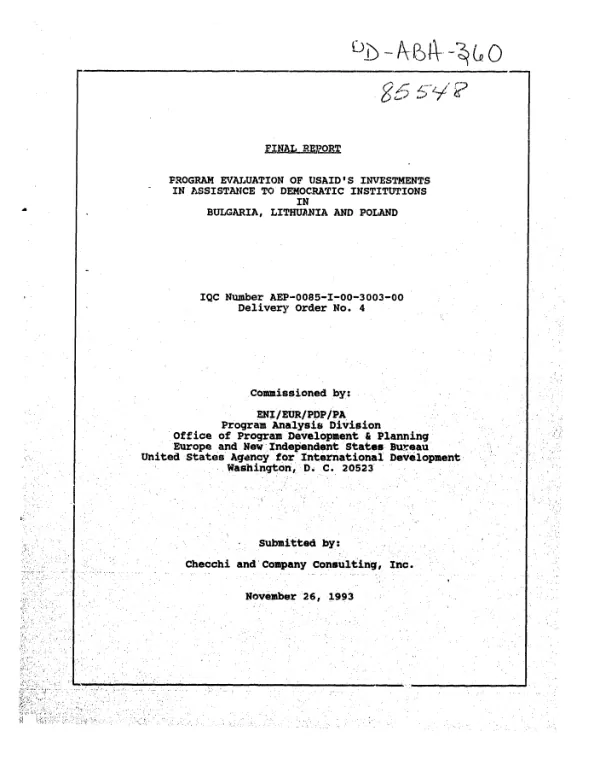
Final report : program evaluation of USAID's investments in assistance to democratic institutions in Bulgaria, Lithuania and Poland
Sign inCHECCHI AND CO. CONSULTING, INC. (CCCI)
Final report : program evaluation of USAID's investments in assistance to democratic institutions in Bulgaria, Lithuania and Poland
Evaluates efforts to promote democratic institutions in Eastern Europe through the Rule of Law (1800020), Education Reform (1800021), and Independent Media (1800022) programs.
Oleson, John|Meagher, Patrick · 1993
Sign in to readA free account is required to download.
Abstract
Interim evaluation covers the period 1991-4/93 and is based on visits to Bulgaria, Lithuania, and Poland. The Rule of Law program's impact is sufficient to justify its continuation in the three countries visited except, possibly, Poland, which is further advanced and where legal authorities have become sensitive to receiving advice from external sources. Efforts should focus on supporting the growing private sector economy and on dealing with economic and organized crime and government corruption. There is no convincing reason to have separate programs run by the Central and Eastern European Law Initiative Program (CEELI) and the U.S. Information Agency (USIA), and there are some disadvantages; CEELI could provide the full range of services required. In-country advisors do not spend enough time in-country or receive enough advance preparation; they should be sent for longer periods, even if this means sending fewer advisors and paying commercial rather than volunteer level compensation. Despite favorable reviews, CEELI's commentaries on draft legislation had little impact on the legislative process and in some instances did not reflect an understanding of the local legal culture and institutions. This aspect of the program should be downplayed and the process modified to address the weaknesses. Also, more attention should be given to linkages to national institutions such as private bar associations and training centers for justice sector personnel. The Education Reform program is the least promising of the three. Little progress has been made in reforming the educational systems inherited from the communist era. The will to reform is weak, and the resource needs large. USIA is using its existing programs and has not modified them to focus on curriculum reform. If continued, the program should include support for the Ohio State Education Program in Poland and modify the USIA exchange programs and the Books for Democracy program so they directly support reform. With help from the Independent Media program, the number of newspapers, periodicals, and private radio stations has jumped significantly in all three countries, and in Poland even the number of private TV channels has increased. The program has had several favorable impacts: it has supported successful private newsgathering and reporting agencies in Lithuania and Bulgaria; helped start or strengthen five private radio stations in Bulgaria; and assisted the Media Resource Center in Poland, which is making such progress that it may develop into a new, practically oriented journalism training institution. Key constraints are the poor economic conditions facing investors (especially in Lithuania and Poland), the lack of a journalistic tradition of fact above opinion, and the lack of practical training in running a commercial media outlet. Given the economic situation, it is important that equipment be supplied to a media outlet only after close review of its economic prospects and business plan, and TA and training for media personnel should focus on practical matters. In addition, the program should be expanded to include establishment/strengthening of national journalism training, again, with a practical focus. In general, USAID field offices lack expertise in program design and monitoring. A.I.D. should establish one or more positions under each program to have multi-country responsibility in these areas. These persons could also give more emphasis to addressing problems on a regional basis and increasing interchange of experience among country-level programs. A.I.D. should also make greater use of in-region institutions and personnel in addressing common problems under the three programs.