CHILDHOPE
Final report : project no. 180-0032 -- street children Albania project "SHEFT"
Final report by the contractor (Childhope International) of a project (3/94-3/97) to support a day-care center for street children in the Albanian capital of Tirana (the SHEFT program).
1997
Sign in to readA free account is required to download.
Abstract
Despite operating in one of the region"s most precarious and fragile democracies and the onset of a high inflation rate, which made it impossible to meet original goals to create an NGO forum and to integrate the community into the program, SHEFT was able to provide services to street children from the most disadvantaged homes. In fact, SHEFT, which was designed to complement existing services for children in Tirana, instead became the focal point for such service delivery, as schools, orphanages, governmental agencies and ministries, and local NGOs lacked the resources needed to address the needs of this growing population. The number of children assisted on the street has doubled since SHEFT"s inception in 1992. In all, more than 150 street children have used the Center"s services. Just prior to the civil unrest in Tirana in early Spring 1997, 100 children (almost all of the street children in Tirana) were coming to the SHEFT Center or were being supported in the streets with food, clothing, and health care and social activities through the street outreach program. Other direct beneficiaries of the project include the families of children, who depend on SHEFT for their children"s health, education, and nutritional needs. The Center is run by a committed staff, which continues to be entirely Albanian, who were provided with training and TA in program management, a difficult task given the Albanians" inexperience in NGO management and the lack of enough grant funds to intensify training accordingly. Children who came to the Center received three meals each day plus a late afternoon snack, a place to shower and wash their clothes, the use of toilets, and clothing if needed. The Center helped them establish a daily routine, which included story telling, singing, games, and reading and writing skills, and primary health care services. The latter prevented children and their families from being affected by an outbreak of cholera in 1994. Thirty-five families of street children received small financial stipends -- about $50.00 a month -- to replace the loss of income from the children"s work on the street. An informal education program was provided for up to 45 children, aged 5-13, at a time. The program, which consisted of recreational and cultural activities, field trips, tutoring, and mentoring, endowed the children with the skills in math, literacy, geography, and history that they needed to return to and succeed in the formal school system; 80% of recipients returned to school where they performed above average. In 1995, SHEFT moved to a larger facility, enabling it to open a night shelter where 24 children receive 24-hour support. In the Summer of 1997, SHEFT moved to an even larger facility. Some in the community have even requested that the Center provide recreational services for the children in the community-at-large. Overall, the need for SHEFT and its services is becoming more evident with the current upheavals in Albania. As the economy worsens, the number of street children, spurred by a large rural migration to the cities, is expected to increase. The streets are also becoming increasingly dangerous; prostitution, sexual exploitation by foreign pedophiles, the use of hard drugs, and involvement in criminal activities are becoming real problems for street children. There is also a growing trade in the trafficking of children to Italy and Greece for the purpose of sexual exploitation and indentured labor. Since government support is not expected anytime soon, the need for long-term external support is essential.
Related documents
Documents in this collection
 2007
2007USAID DEC
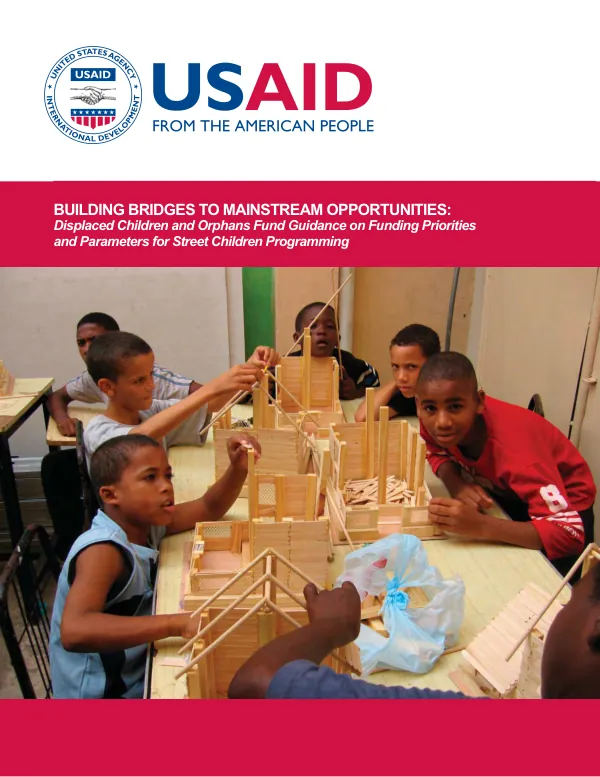
Building bridges to mainstream opportunities : Displaced Children and Orphans Fund guidance on funding priorities and parameters for street children programming
Open record![POMMAR [Preveno orientada aos meninos e mininas em situacao de risco = Prevention oriented towards at-risk boys and girls] : annual report -- year VII, 2001](https://covers.devme.ai/gen/82249.webp) 1970
1970USAID DEC
![POMMAR [Preveno orientada aos meninos e mininas em situacao de risco = Prevention oriented towards at-risk boys and girls] : annual report -- year VI, 2000](https://covers.devme.ai/gen/23905.webp)
![POMMAR [Preveno orientada aos meninos e mininas em situacao de risco = Prevention oriented towards at-risk boys and girls] : annual report -- year VIII, 2002](https://covers.devme.ai/gen/50326.webp)