ACADEMY OF SCIENCES OF THE CZECH REPUBLIC
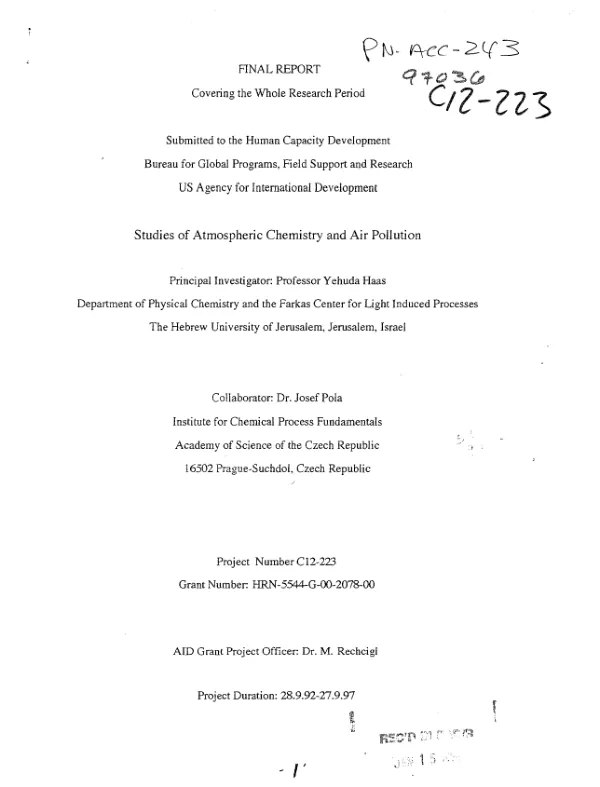
Final report : studies of atmospheric chemistry and air pollution
This report presents results of a case study, in the Czech Republic, of the reaction of ozone with olefins, a major cause for air pollution.
Haas, Yehuda; Pola, Josef · 1970
Sign in to readA free account is required to download.
Abstract
An in depth study of olefin ozonation was performed in cryogenic matrices and in the gas phase. Particular attention was given to the role of secondary ozonides, reactive species that were previously observed in solution, but whose presence in the gas phase (under atmospheric conditions) was dubious. Unequivocal evidence was provided that these compounds are indeed formed in the gas phase. Some of their subsequent reactions were also studied, leading to the characterization of gas phase products. It was found that the final product distribution is strongly temperature-dependent. This finding must be considered in future work that will attempt to simulate the entire chemical processes involved in ozone-olefin chemistry, during day and night at different latitudes and climate conditions. The work also included a spectroscopic and kinetic study of the reaction at cryogenic matrices, allowing a more complete spectroscopic characterization of the primary and secondary ozonides than previously possible. The project analyzed environmental effects on the reactivity of the system, which may be of relevance to reactions of ozone in aerosols and on surfaces (such as dust particles). Theoretical aspects of the reaction were also studied, using quantum chemical methods and computations. This study led to a unified view of the reaction for different olefins as well as predictions that were subsequently verified experimentally. During the project, the Czech laboratory was equipped with modern instrumentation, making it a leading institute in the field. Techniques and skills developed in the project will be used to further study problems related to atmospheric chemistry, as well as other gas phase reactions. (Author abstract)
Related documents