USAID DEC
Final report : Swaziland cropping systems research and extension training project, 1981-1991, project no. 645-0212, contract no. AFR-0212-C-00-2006-00
Sign inPENNSYLVANIA STATE UNIVERSITY. COLLEGE OF AGRICULTURE
Final report : Swaziland cropping systems research and extension training project, 1981-1991, project no. 645-0212, contract no. AFR-0212-C-00-2006-00
Final contractor report on a project (4/82-8/91) to strengthen the capacity of Swaziland"s Ministry of Agriculture and Cooperatives (MOAC) to conduct research and extension oriented toward the needs of the primarily subsistence cultivators living on Swazi Nation Land (SNL).
1991
Sign in to readA free account is required to download.
Abstract
Throughout the project, highest priority was given to education: 22 Swazi"s received M.S. degrees and 6 received B.Sc."s. Swazi participants in academic programs achieved a phenomenal 90% "completion to degree" rate. All 28 Swazis receiving academic degrees returned home to accept positions in the MOAC or the private sector. A Swazi with an M.S. now directs each of the discipline based units within the MOAC"s Research Station, and many of Extension"s National Subject Matter Specialists hold advanced degrees. In addition, 38 Swazis received short-term extension or management training. The following achievements can be counted as well. (1) A research/extension planning process has been institutionalized within the MOAC. The Ministry has publicly stated that funds will be budgeted to continue the planning process after the completion of the project. (2) Several extension factsheets and field support guides were developed for SNL farmers. These and other information were pulled together into a 450-page Farmer"s Handbook as a one-volume basic reference for frontline extension workers. (3) A large number of on-farm research and extension trials were conducted. This effort is being institutionalized with the posting of research assistants in rural areas. (4) An in-service training plan has been implemented. All 159 frontline extension workers now receive at least 2 weeks of inservice training each year. (5) Computers, VCR"s, audio and video equipment, still cameras, and equipment for a print shop were acquired (and individuals were trained to use them) as a means of enhancing communication within MOAC and supporting extension. (6) A longitudinal impact assessment based on surveys of SNL farmers found significant increases in the number of farmers who use MOAC-recommended practices and who are self-sufficient in maize. This assessment is included among the appendices. (Author abstract, modified)
Related documents
Documents in this collection
 1991
1991USAID DEC
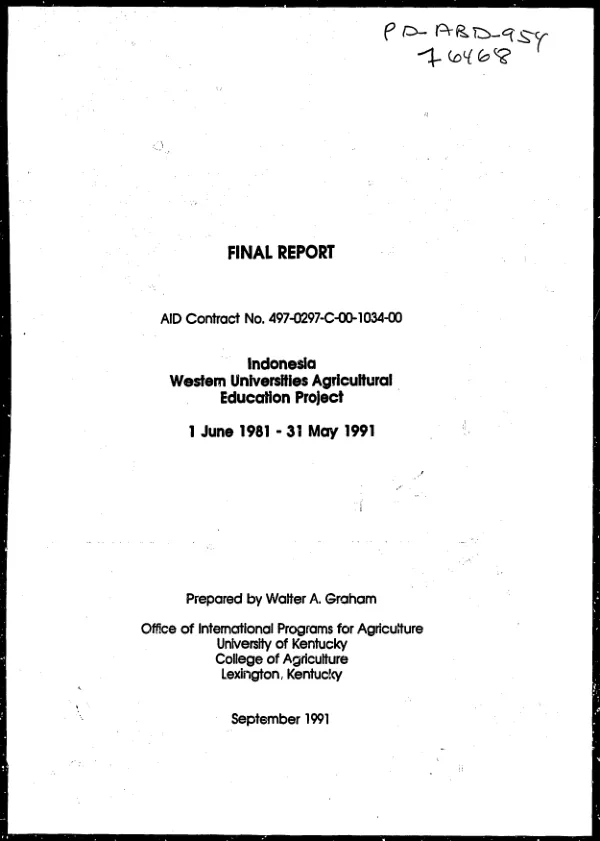
Final report : AID contract no. 497-0297-C-00-1034-00 -- Indonesia western universities agricultural education project, 1 June 1981-31 May 1991
Open record 1981
1981USAID DEC