USAID DEC
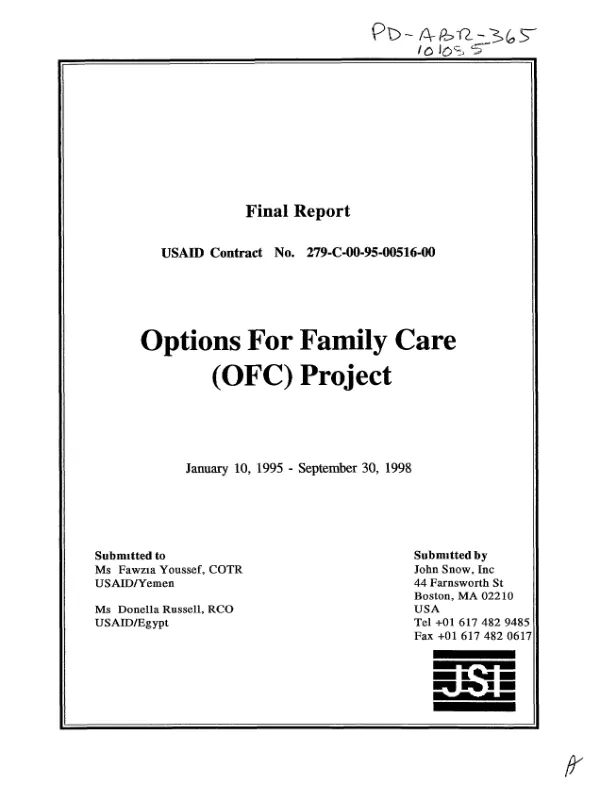
Final report : USAID contract no. 279-C-00-95-00516-00 -- options for family care (OFC) project, January 10, 1995-September 30, 1998
Sign inJOHN SNOW, INC. (JSI)
Final report : USAID contract no. 279-C-00-95-00516-00 -- options for family care (OFC) project, January 10, 1995-September 30, 1998
Final report of the main contractor, John Snow, Inc.
1970
Sign in to readA free account is required to download.
Abstract
(JSI), on a project (1/95-9/98) to develop a model to improve the delivery of maternal/child health and family planning (MCH/FP) services in Yemen. Achievements under the three project components were as follows: The first component trained community midwives and female primary health care workers for service in rural areas. Almost 700 candidates applied for the 220 places available in the training program, which was preceded by a training of trainers (TOT) workshop for 20 trainers. To provide critically needed practical experience in delivering babies, groups of trainers and trainees were temporarily moved to higher volume delivery facilities, such as urban hospitals. Project staff worked closely with the MOPH so that graduates would be hired immediately upon certification by the Health Manpower Institute/Sana"a. Communities participated in the trainee recruitment process and provided material support to both trainees and trainers. By the end of the contract, about 200 trainees were attending the program. In the second component, to help health centers meet minimum quality standards, the project improved refresher training capacity, health facilities and equipment, and clinical and management practices. To improve refresher training, the project developed governorate training teams and provided clinical workshops in acute respiratory infection treatment, health management information system (HMIS) management, and midwifery skills. In 1997, the focus of in-service training shifted to on-site, mini-workshops and on-the-job training in order to accelerate skills improvement. To improve health center facilities, a basic list of clinical and training equipment was procured from the United States for 22 health centers and 60 health units, where community midwives could practice upon graduation. In addition, 31 facilities were renovated to provide adequate space to accommodate all basic MCH/FP services, including prenatal care, FP counseling and services, child health, delivery, pre- and post-delivery care, health education, immunization, registration, and waiting areas, and, in some cases, to function as training centers. Efforts to improve the quality of care focused on the priority problem areas of infection prevention, FP, antenatal care, diarrheal diseases, immunization, record keeping, drug supply and user fees, and the use of protocols for service delivery. TA emphasized areas most in need of improvement and those that would have the largest impact on improving service quality. TA in outreach strategies was also provided, especially during the final year of the contract, and had a positive impact on improving provider performance and service quality. The project also developed two checklists to monitor and measure the quality of care. Management improvements included the introduction of a reliable HMIS system and management training on issues key to service quality and the organizational relationships supporting them. A user fee system was implemented at 85% of the centers in Hajjah and Hodeidah. Implementation in Hadramaut is pending. To improve community participation, the project implemented Community Partnership Agreements that identified the roles and responsibilities of the project, the community, the health center, and the governorate Health Office in improving the quality and quantity of MCH/FP services. It also facilitated the establishment of local health committees to support the health centers. Contract performance was very good; 15 of 17 target indicators were met or exceeded. Of the two that were not met, one reached 53% of target, the other, 55%. The model developed under the project appears to be generally replicable in Yemen (although with certain modifications and provisos). The MOPH, other donor agencies, and NGOs would be well served in adopting the basic model as a guide for improving health care service delivery.
Related documents
Documents in this collection
 1970
1970USAID DEC
The MCH/FP health center improvement model : a model for the sustained delivery of improved MCH/FP services as demonstrated in the Options for Family Care Project, Republic of Yemen, 1995-1998
Open record 1970
1970USAID DEC