ABT ASSOCIATES, INC.
Financial and trade liberalization and the agricultural sector
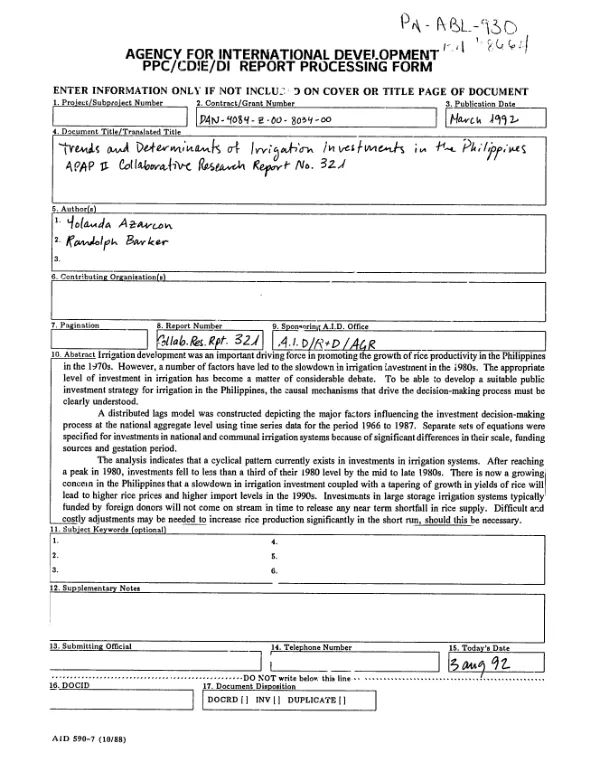
In the past five years the Philippines have become more receptive to further economic liberalization measures, including those within the agricultural sector.
Lamberte, Mario B. · 1992
Sign in to readA free account is required to download.
Abstract
Although this study considers the impact of both the financial and trade liberalization measures on the agriculture sector, more emphasis is given to the former. The main reason for this bias is that existing literature has very limited discussions of this issue. Thus, more discussions are devoted to some aspects and experience of the Philippines with financial liberalizations with special reference to the agriculture sector. The next chapter briefly discusses the role and contribution of the agriculture sector to the economy. It also briefly reviews the changes in Philippine agricultural policy over the last twenty years. Chapter 3 discusses some issues of financial liberalization. More specifically, it reviews changing views of the character of government intervention in the financial markets. Chapter 4 presents an extensive discussion of the evolution of the general financial and agricultural credit policy in the Philippines. It also assesses the performance of the financial sector. The results of the analysis of the previous chapter and this chapter provide a useful background for analyzing the reforms that have been most recently implemented or are currently contemplated. Chapter 5 provides a quantitative analysis of the likely effects of various financial and trade liberalization measures on the agriculture sector. A simulation analysis using a macroeconometric model is performed. The last chapter summarizes the major findings of the study and discuses some policy implications. (Author abstract)
![Impact of trade liberalization on the Philippine economy : a CGE [computable general equilibrium] modeling approach](https://covers.devme.ai/gen/14535.webp)