EXPERIENCE, INC.
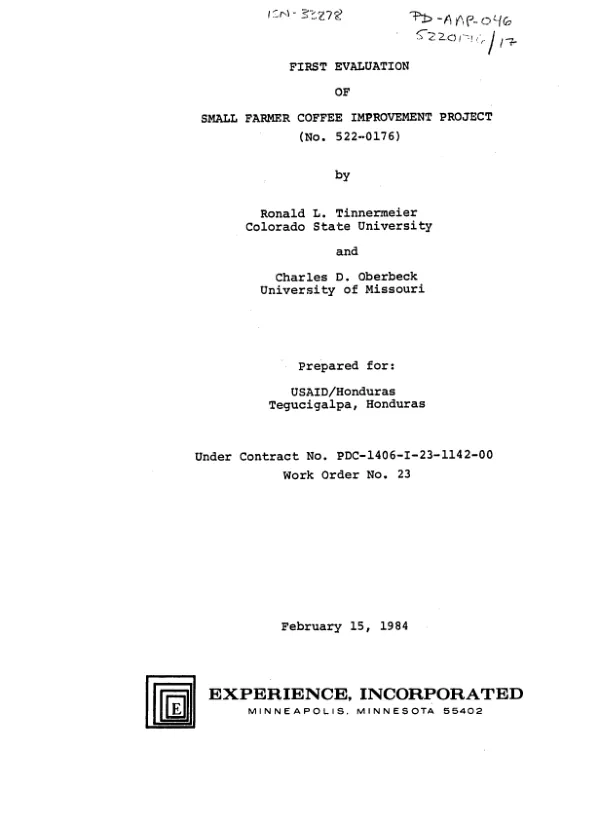
First evaluation of small farmer coffee improvement project
Evaluates project to mitigate the production impact of coffee rust fungus in Honduras by providing small farmers with credit and technical advice.
Tinnermeier, Ronald L.|Oberbeck, Charles D. · 1984
Sign in to readA free account is required to download.
Abstract
Special evaluation covers the period 6/81-12/83 and is based on document review, site visits, and interviews with USAID/H, Honduran Coffee Institute (IHCAFE), and bank personnel, and with farmers and extension agents. Although implementation was seriously delayed during the first year due to a change in higher administration, a drop in revenue from coffee exports (causing a severe cut in IHCAFE's operating budget), and a 5/82 stoppage in A.I.D. funding, very satisfactory progress is now being made. IHCAFE is improving its effectiveness in coordinating extension, credit, and nursery activities and the project has already reached some 1,600 small farmers, who are using project credit to establish seedling nurseries and to renovate their coffee fields in line with the recommendations of IHCAFE extension agents. Increased farmer productivity is virtually guaranteed. (A delay in late 1983 in getting improved seed for some nurseries is not expected to cause any serious problems.) The extension service is making definite progress in developing techniques (e.g., group training, demonstration plots) for working with small farmers, but its ability to reach more farmers has been limited due to a cutback in field staff and a heavy workload in supervising farmer loans. Also, there is a large degree of variability in individual agents' capabilities. Improved inservice training, better farmer training aids, increased supervisory support for agents, and more field personnel are among this component's key needs. The three banks (BANDESA, BANHCAFE, and Banco de Occidente) participating in the credit program are administering credit adequately, but reimbursement through the Ministry of Finance and the Central Bank is not working well, causing occasional shortages of funds to be onlent to farmers. Interest repayments are at the 90-95% level; principal repayments have not yet come due. The major lessons learned in this project are: (1) the importance of providing profitable technical recommendations to accompany credit; and (2) the difficulty of channeling funds through the entire financial system. Numerous recommendations are included.