INTERNATIONAL SCIENCE AND TECHNOLOGY INSTITUTE, INC. (ISTI)
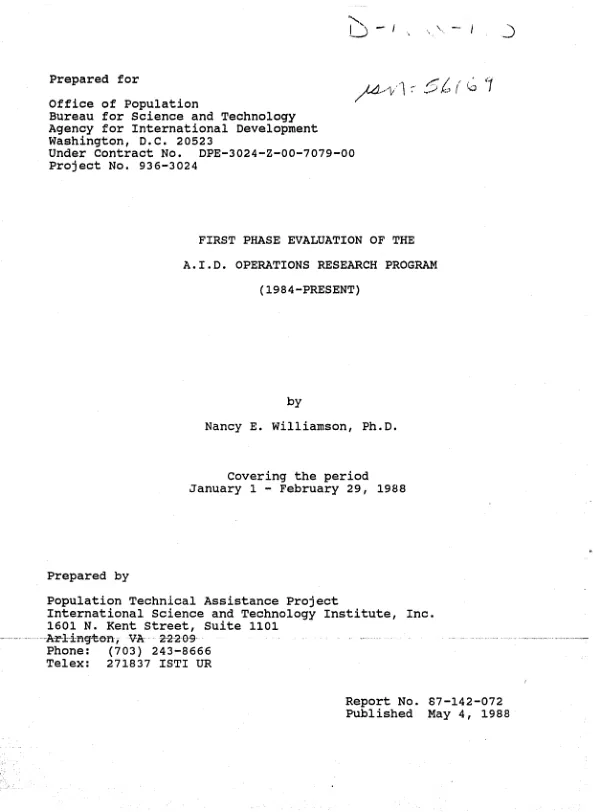
First phase evaluation of the AID operations research program (1984-present)
Evaluates Phase I (1984-4/88) of a project to conduct operations research (OR) aimed at improving family planning (FP) programs.
Williamson, Nancy E. · 1988
Sign in to readA free account is required to download.
Abstract
The evaluation is based largely on interviews and compares the present project with the previous OR program (1973-84). This project has continued A.I.D."s OR program in: providing TA and financial support to improve FP delivery in LDC"s through subprojects (SP"s) that diagnose existing service delivery problems; testing new approaches to service delivery; and collecting and disseminating information useful for improving service delivery. Prior to this project, SP"s involved household- and community-based distribution of pills, condoms and, less often, spermicides in rural areas; contraceptives and services were generally provided for free. Studies often used baseline and endline surveys and quasi-experimental designs and were mainly interested in contraceptive prevalence (CP); the methodology was one of testing different approaches ("learning by doing"). Only about a third of the more recent SP"s follow this model. Newer SP"s are more likely to: be clinic based and set in urban areas; feature paid services or purchased commodities; stress referrals and information, education, and communication; and promote male methods and IUD"s. Output measures increasingly focus on cost-effectiveness, self-sufficiency, and efficiency rather simply CP. Although quasi-experimental designs still predominate, more of the recent studies have no control group and could be considered diagnostic studies. Data collection is now most frequently based on service statistics, service provider and patient/client interviews, administrative/cost records, and qualitative approaches. Those interviewed for the evaluation unanimously supported the continuance of the OR program, which has to a considerable extent become localized and is now meeting country and project level needs for improving FP service delivery. The technical contributions of the OR staff in Washington (OR/W) were mentioned frequently. Critical comments emerging from the interviews included: (1) inadequate attention by OR/W to institution building; (2) in some cases, a rigidity inhibiting adaptation to local conditions; (3) the program"s lack of visibility to those not directly participating and its separateness from other A.I.D. FP evaluation activities; (4) occasional micro-managing by OR/W, leading to SP delay; and (5) overemphasis on the number of SP"s initiated and on CP at the expense of TA and more general and cross-regional products. The interviews revealed that OR/W is aware of these problems - a fact of which field staff may not be aware. A 5-year extension is recommended. Other recommendations address the problems noted above. (Author abstract, modified)