USAID. MISSION TO INDONESIA
Fisheries research and development project
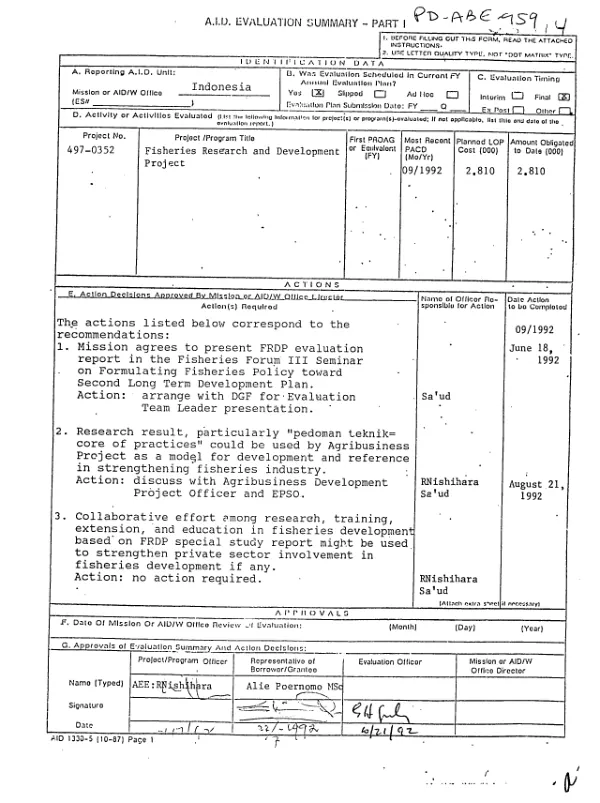
Summarizes attached final evaluation (XD-ABE-959-A) of a project (8/86-9/92) to upgrade fisheries research and development in Indonesia.
1992
Sign in to readA free account is required to download.
Abstract
The project has produced valuable outputs in both the public and private sector. It has developed national policy agendas by networking government agencies, fisheries organizations, and the private sector, and through publication of the proceedings of annual fora. In fact, the project"s forum process is regarded as a model for other agricultural sectors. Long and short-term training were successful. All 13 graduate fellows have returned or are returning to Indonesia, and have been placed in positions where they can apply their knowledge. Over 100 short-term training sessions and workshops were conducted; particularly successful were efforts to train trainers and involve NGO"s in training and extension. The 22 research grants and 11 special studies have added to the national fisheries information base and enhanced the competency of grantees, both individuals and organizations. The 25 mini-technology packages (Pedoman Teknis) produced under the project are an effective means of transferring technology from the research to the field level; other, more field-oriented technology packages (Paket Teknologi) have helped to create an industry in intensive culture of freshwater fish in low-volume cages. The project"s links to the private sector have benefitted small fisherpeople and should provide future impact, particularly through work with NGO"s. The project involved women at all levels, especially in technology transfer. Auburn University performed well as the prime contractor, and the Agency for Agricultural Research and Development (AARD) was an effective and cooperative counterpart, even though certain aspects of the project were outside its mandate. Mission recommendations are that: (1) the Government of Indonesia (GOI) decentralize the process of preparing tek-paks, make more use of NGO"s for extension, and make research more responsive to regional needs; (2) the GOI support the creation of a Fisheries Department at the Institute of Socio-economic Studies at Bogor; (3) more workshops be held on fish hatcheries, especially floating hatcheries in the Cirata/Saguling region; (4) and any funds remaining when the project ends be used for short courses for women only, e.g., in fish hatchery technology. Lessons learned included the following. (1) Major mid-project revisions of purpose place a burden on the contractor and counterpart agency. (2) Counterpart agencies must have a legal mandate to perform the activities expected of them. (3) TA projects in support of such a diverse sector such as fisheries should stress one or two components, rather than undertake superficial activities in a large number of components. (4) Local NGO"s are most effective in communicating technology transfer and extension at the level of the primary producer. (5) Short-term technical courses should be a minimum of 4 weeks long, emphasize hands-on training, and include follow-up. (6) Special seminars are not particularly valuable unless part of a formal structured plan.